

THAILAND
LAND BRIDGE
THE $31 BILLION BET
A complete expert analysis of the megaproject designed to bypass the Strait of Malacca — what it is, who’s driving it, whether it can work, and what it means for the planet’s trade arteries.
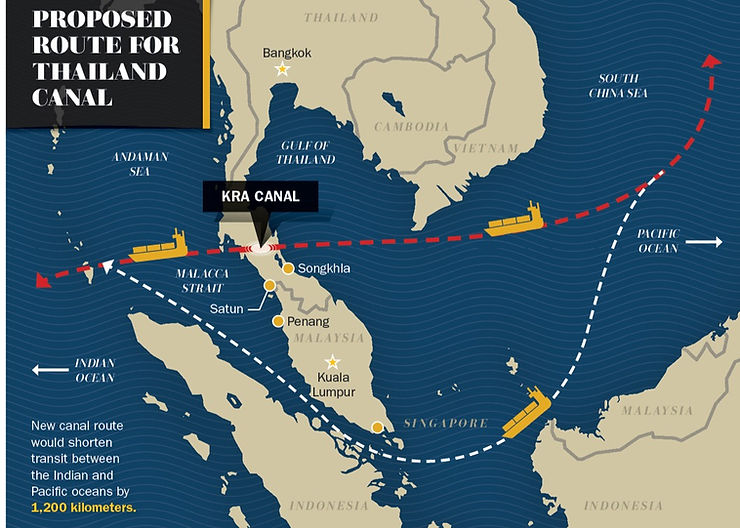
The proposed Thailand Land Bridge corridor across the Kra Isthmus — connecting Ranong on the Andaman Sea to Chumphon on the Gulf of Thailand. Source: straitmalacca.com
What Is the Thailand Land Bridge?
The Thailand Land Bridge — officially called the Southern Land Bridge or the Chumphon–Ranong Corridor — is a proposed $31 billion overland freight corridor designed to link two new deep-sea ports on opposite coasts of southern Thailand, creating a trans-peninsular route that bypasses the Strait of Malacca entirely.
The project would stretch approximately 87–90 kilometres across the narrowest section of the Malay Peninsula — the Kra Isthmus — connecting Ranong Port on the Andaman Sea (Indian Ocean side) to Chumphon Port on the Gulf of Thailand (Pacific side). These two deep-sea ports would be linked by a dual-track railway, a four-lane motorway, and potentially oil and gas pipeline infrastructure.
In simple terms: cargo ships from the Middle East, Africa, or Europe would call at Ranong, offload containers onto rail or trucks, transit the 87 km overland corridor, and reload onto ships at Chumphon for onward delivery to China, Japan, South Korea, and Pacific markets — skipping the entire southern portion of the Malacca route, including the congested waters around Singapore.
The Thai government’s Office of Transport and Traffic Policy and Planning (OTP) approved the project framework and described the first phase as targeting completion by 2030, with full operations by 2039. Ranong Port is projected to handle approximately 19.4 million TEUs (twenty-foot equivalent units), while Chumphon is projected to manage 13.8 million TEUs.
What Problem Is It Solving?
The Land Bridge exists to address two interlinked problems: the Strait of Malacca’s capacity constraints and the strategic vulnerability it creates for every nation that depends on it.
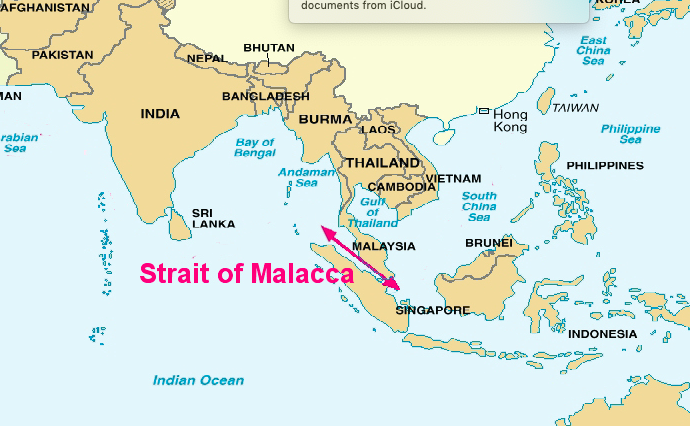
As detailed in our analysis of the Strait of Malacca Dilemma, the strait is one of the world’s most critically important — and dangerously narrow — maritime chokepoints. Over 100,000 vessels transit it annually, and its narrowest navigable channel is just 2.8 kilometres wide. The strait is progressively approaching capacity saturation, and the risk of a catastrophic blockade, whether through military conflict, piracy, or environmental disaster, is a genuine concern for every major importing economy in Asia.
For China specifically, approximately 80% of its oil imports pass through the strait, creating the strategic vulnerability President Hu Jintao famously called the “Malacca Dilemma” in 2003. A U.S. or allied naval blockade of Malacca in a conflict scenario could rapidly cripple China’s economy without a single shot being fired on Chinese soil.
For Thailand, the problem is more economic than strategic. The country has faced sluggish GDP growth, limited infrastructure investment, and a need to transform its southern provinces — among the least developed in the country — into an engine of growth. The Land Bridge offers a way to leverage Thailand’s unique geographic position as the land bridge between the Indian and Pacific Oceans.
“This idea has been around in one form or another for around 300 years. It resurfaces every time the Thai economy is on the skids because governments see it as a way to create jobs, attract investment and generate revenue.”
— Ian Storey, Senior Fellow, ISEAS–Yusof Ishak Institute, SingaporeThe project’s backers point out that routing through Malacca currently adds unnecessary distance and time for vessels trading between the Indian Ocean and the Pacific. Ships from Jeddah or Djibouti bound for Shanghai or Osaka must navigate the entire Malacca route, adding days of transit. An efficient Kra Isthmus corridor could shave roughly 1,200 kilometres off some routes — or approximately four days of sailing time, as the Thai government consistently claims.
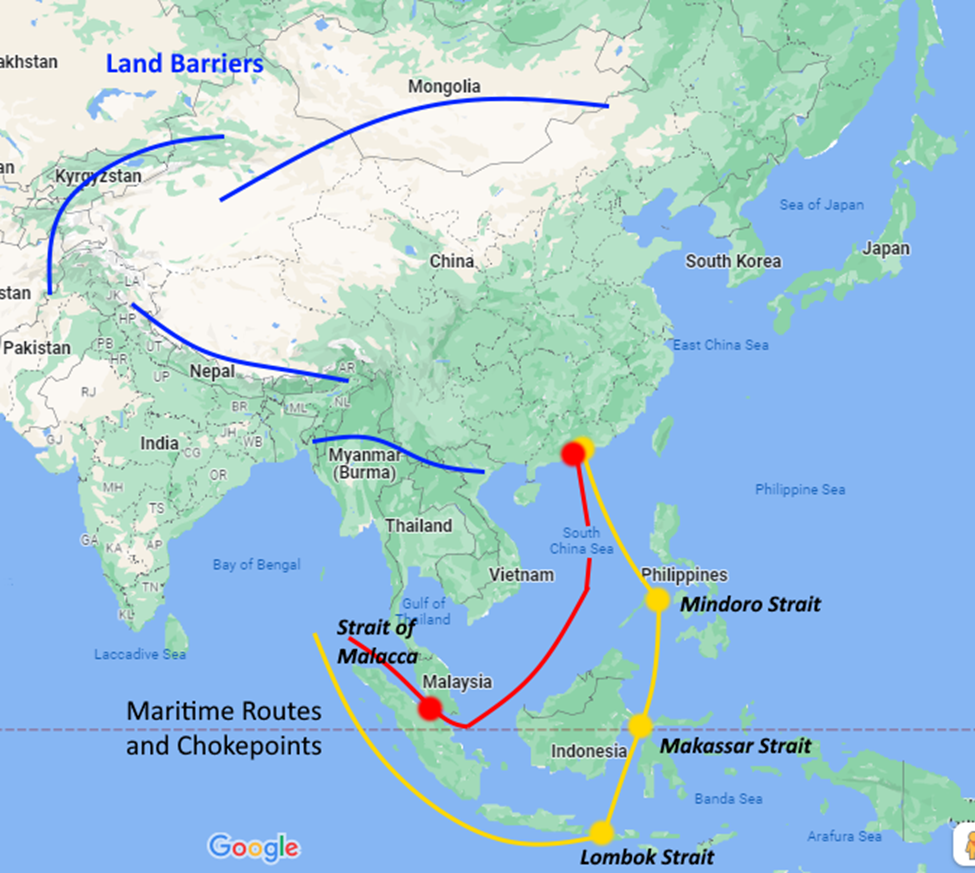
Land Bridge vs. Kra Canal: What’s the Difference?
These two terms are frequently confused, but they describe fundamentally different engineering solutions to the same geographic problem. Understanding the distinction is essential to evaluating either project’s viability.
| Factor | 🛤 Thailand Land Bridge | 🚢 Kra Canal (Thai Canal) |
|---|---|---|
| Concept | Overland freight corridor (rail + road + pipelines) | Fully navigable waterway cut through the peninsula |
| Route | Ranong (Andaman) → Chumphon (Gulf of Thailand), ~90 km | 102–135 km canal through the Kra Isthmus |
| Ship transit? | No — cargo is unloaded, transported, reloaded | Yes — ships sail through the canal directly |
| Estimated cost | ~$31 billion (997 billion baht) | $28–$30 billion (estimates vary widely; some say $100B+) |
| Construction time | 7–9 years (target: complete by 2039) | 8–10+ years (theoretical) |
| Environmental impact | High — ports, coastal ecosystems, Ramsar wetlands | Catastrophic — permanent division of peninsula, marine ecosystems |
| Political feasibility | Moderate — debated but advancing in Thai government | Low — no formal government backing; security concerns in Muslim south |
| Who wants it? | Thai government, China (interest), Saudi Arabia, U.S. (cautious support) | Historically China; Thailand has largely shelved it |
| Status (2026) | Feasibility studies completed; Cabinet proposal expected June–July 2026; tender planned | No formal government proposal; remains conceptual |
| Singapore impact | Moderate threat to transshipment dominance | Existential threat — Singapore expresses strong opposition |
| Key logistical flaw | Cargo must be unloaded and reloaded — adds time and cost | Canal locks needed for tidal difference; giant tankers may not fit |
| Security risk | Southern Thailand insurgency; single private operator control | Would physically divide Muslim-majority south; insurgency risk amplified |
The critical difference is that a canal allows ships to sail through uninterrupted, while a land bridge requires two complete cargo operations — unloading and reloading at each port. Shipping industry experts have consistently identified this as the land bridge’s fundamental vulnerability: the added time and cost of transshipment may negate much of the theoretical four-day saving, particularly for ultra-large container vessels that benefit from scale economics.
Timeline: From Concept to Cabinet — and What Comes Next
Who Is Behind It? The Political Forces Driving the Land Bridge
The Thailand Land Bridge has been championed by successive Thai administrations since 2021, but its current momentum comes from a specific confluence of political and geopolitical interests.
The Thai Government: Anutin Charnvirakul Administration (2025–Present)
Thai Prime Minister Anutin Charnvirakul has made the Land Bridge a centrepiece of his economic agenda, framing it as the transformational megaproject that will position Thailand as a global logistics hub. His Deputy PM and Transport Minister, Phiphat Ratchakitprakarn, has been the project’s most vocal champion — declaring in April 2026 that the Hormuz crisis had “demonstrated the advantage” of controlling key transport routes, and using it to argue for accelerating the Land Bridge’s development.
Phiphat subsequently ordered a fresh review of feasibility work in December 2025 after persistent objections from opposition legislators and environmental groups, but simultaneously declared intent to accelerate the planning phase — a contradictory posture that has deepened critics’ suspicions about the project’s transparency.
The Chinese Interest
China’s strategic interest in the Land Bridge is substantial but officially restrained. Beijing views any alternative to the Strait of Malacca as directly addressing its Malacca Dilemma. China Harbor Engineering Co., a state-owned infrastructure developer, expressed interest after meeting PM Srettha at the Belt and Road Forum in Beijing in October 2023. China’s BRI apparatus has provided the broader framework within which such infrastructure investments are evaluated.
However, Thailand is acutely aware of the geopolitical risks of becoming over-dependent on Chinese investment — and has deliberately sought to balance Chinese interest with investment from Saudi Arabia, Japan, and Western partners. According to the ISEAS–Yusof Ishak Institute, Thailand is pursuing a “Saudi Arabia first” investment strategy to avoid excessive Chinese dependence.
The United States: Cautious Support
Washington views the Land Bridge — the overland variant — as preferable to the Kra Canal, because it provides an alternative logistics route without giving China an unimpeded sea lane bypass that would directly diminish U.S. naval leverage in the region. The U.S. has increased maritime cooperation with Thailand and other ASEAN states partly as a counterweight to Chinese infrastructure influence in the region.
Singapore: Interested but Nervous
Singapore’s position is fascinatingly ambivalent. The city-state’s entire economic model is built on its position as the gateway through which Malacca traffic flows. A successful Land Bridge that diverts significant transshipment away from Singapore would be economically damaging. Yet Singapore is also a major potential investor in the project — and its inclusion as a stakeholder could ensure the Land Bridge is designed in a way that complements rather than replaces Singapore’s role. Singapore’s Coordinating Minister for Public Services Chan Chun Sing met Thai PM Anutin on April 27, 2026. Government spokesperson Rachada Dhnadirek confirmed Singapore had “expressed interest but had not yet committed to any specific role.”
Is It Practical? The Case For and Against
This is the question that divides shipping analysts, economists, environmentalists, and politicians. The answer is genuinely contested — and the recent surge of critical assessments from Thailand’s own academic institutions makes it more contested than ever.
The Case For the Land Bridge
Proponents point to four core arguments. First, the time and cost savings are real: cutting four days off the voyage from the Middle East to East Asia, and reducing logistics costs by 15%, is commercially meaningful at scale. Second, Thailand’s geographic position is irreplaceable — no other country sits at the junction of the Indian and Pacific Oceans with a land crossing this short. Third, the Malacca Dilemma is intensifying: with U.S.–China tensions rising and the Hormuz crisis adding urgency in 2026, the strategic case for an alternative route is stronger than ever. Fourth, the project’s EIRR (Economic Internal Rate of Return) of 17.38% — as calculated by the OTP — suggests meaningful economic returns at the national level.
The Case Against
The criticism is formidable and comes from multiple directions simultaneously.
The transshipment problem: Unlike a canal — where ships sail through without stopping — the Land Bridge requires every cargo load to be unloaded at Ranong, transported 90 km by rail or truck, and reloaded at Chumphon. This adds handling time, stevedoring costs, and introduces the risk of cargo damage. A former Bangkok deputy governor told the Bangkok Post that the project’s feasibility study “seems engineered to justify the investment, but if you speak to real players in the maritime industry, the numbers simply don’t add up.”
Private investor returns are unattractive: The opposition People’s Party MP Sirikanya Tansakun cited OTP findings showing that while the overall project yields a return of roughly 8%, the return for private investors drops to about 5% — with a negative net present value. This is deeply problematic for a project structured as a Public-Private Partnership where the entire construction cost is meant to come from private capital.
The Chulalongkorn verdict: In April 2026, a study by the NESDC and Chulalongkorn University assessed four development options for the region. It ranked the Land Bridge third — describing it as the least suitable option when weighed against cost and strategic value. The top-ranked option focused on maximizing existing Thai coastal assets without building a new cross-peninsula link.
Perhaps the most explosive challenge to the project in 2026 is the environmental data controversy. Marine scientist Thon Thamrongnawasawat of Kasetsart University published research showing that official EHIA documents estimate 1.524 billion benthic (seabed) organisms would be affected by the Ranong port construction. Independent field surveys by Prof. Sakdi-anan Plathong found an average density 35 times higher — suggesting the true figure could be 53.953 billion organisms. The difference: 52.4 billion animals — an “enormous gap” with profound implications for ecological compensation and project viability.
Compounding this, Thailand’s Andaman coastline — including the proposed Ranong port area — is part of a UNESCO World Heritage tentative listing covering six national parks. Critics argue the Land Bridge could permanently disqualify this listing, sacrificing long-term tourism revenue for infrastructure that may never attract sufficient shipping.
No cargo generation of its own: Veteran infrastructure analyst Samart Ratchapolsitte argues that unlike Map Ta Phut Port — which succeeded because large industrial estates generated its cargo base — the Land Bridge corridor has no equivalent freight generator. Without a critical mass of industrial development anchored to the corridor, shipping companies have no commercial reason to divert from the Malacca route.
The Thailand Land Bridge addresses a genuine problem with a geographically logical solution. But its commercial viability rests on assumptions — about shipping diversion rates, private investor appetite, environmental clearances, and cargo generation — that remain unproven and increasingly contested. As of May 2026, this is a project with compelling strategic logic and deeply uncertain execution.
How Much Will It Cost — and Who Pays?
The Land Bridge’s price tag has been revised repeatedly. The original figure of 1 trillion Thai baht has been adjusted to 997 billion baht (~$31.5 billion at current exchange rates) to reflect current economic conditions. This remains one of the largest infrastructure investments in Southeast Asian history.
The financing model is a Public-Private Partnership (PPP) Net Cost model with a 50-year concession. A single private consortium will be awarded exclusive rights to construct and manage the entire project — both ports, the rail corridor, the motorway, and potentially the pipelines — under a single contract. The Thai state’s contribution is expected to be limited, with the private concession holder bearing the bulk of construction and operational risk.
This model’s attractiveness depends entirely on projected traffic volumes and revenue. With private investor returns estimated at just 5% and a negative net present value according to OTP’s own analysis, the challenge of assembling a credible private consortium is substantial. By comparison, major port and infrastructure concessions globally typically target returns of 8–12% to attract tier-one institutional capital.
Funding interest has been expressed from:
- China Harbor Engineering Co. (Chinese state-owned) — expressed interest at Belt and Road Forum, October 2023
- Saudi Arabia (sovereign wealth) — Thai government’s preferred lead investor to avoid Chinese dominance
- Singapore — expressed interest but made no commitment; discussed at April 2026 bilateral meeting
- Japan — roadshow conducted; interest noted but no commitment
- U.S. private equity / infrastructure funds — interest confirmed but scale unclear; U.S. government prefers land bridge to canal on geopolitical grounds
- Middle East sovereign funds (UAE, Qatar) — potential interest given energy pipeline component
No formal financial commitment has been secured from any international investor as of May 2026. The Cabinet proposal expected in June–July 2026 will be a critical test of investor confidence.
Key Players and How They Benefit
Gains a transformational infrastructure legacy, 280,000 jobs, GDP growth of ~1.5%, and positions Thailand as ASEAN’s new logistics hub. Ruling parties have used the project for domestic political capital since 2021.
Reduces Malacca Dilemma vulnerability. Chinese state companies profit from construction contracts. Reduces dependence on a U.S.-dominated chokepoint. Extends BRI influence into Southeast Asia’s land corridor.
Investment in the corridor secures access to a Malacca-independent route for Saudi crude destined for East Asia. Diversifies petrostate investment portfolio. Thailand courts Saudi Arabia as an alternative to Chinese dominance.
Faces potential diversion of transshipment traffic. But as an investor, could shape the project’s design to minimize competitive impact and maintain a role in regional maritime services. Currently expressing “interest without commitment.”
Prefers the overland Land Bridge to a canal, which would give China unimpeded sea-lane access. Uses its support as leverage to maintain Thai alliance relationships and counter BRI influence in Southeast Asia.
Both nations are critically dependent on energy imports through Malacca. A viable alternative corridor reduces their exposure to any Malacca disruption. Both are potential users of a completed Land Bridge and potential infrastructure investors.
The single consortium awarded the 50-year PPP contract will control one of Asia’s most strategically significant infrastructure assets. Transit fees, port revenues, logistics services, and potential pipeline throughput all flow to this entity.
Local fishing communities in Ranong and Chumphon face displacement and livelihood destruction. Marine scientists warn of ecosystem catastrophe. Civil society groups are demanding transparent EHIA processes and full public hearings. Currently the most powerful brake on the project’s timeline.
Global Implications: What the Land Bridge Means for the World
If the Thailand Land Bridge is built and reaches meaningful capacity, its implications extend far beyond Thailand’s GDP statistics. It would constitute the most significant restructuring of Indo-Pacific maritime trade since the opening of the Suez Canal.
For Global Shipping
A functional Land Bridge would, over time, divert a portion of the roughly 100,000 vessels currently transiting the Strait of Malacca annually. Even capturing 10–15% of current Malacca traffic would represent a transformative shift in Asia’s shipping geography. Freight rates on Malacca-routed services could fall as competitive pressure from the Land Bridge route increases. Singapore’s dominance as a transshipment hub — currently second only to Shanghai globally — would face its first serious structural challenge in decades.
For China’s Strategic Position
A completed Land Bridge would meaningfully reduce China’s Malacca vulnerability. Oil tankers from the Persian Gulf could offload at Ranong, pipe crude overland to Chumphon, and load onto coastal tankers for Chinese ports — entirely bypassing the Malacca chokepoint. Combined with the China–Myanmar pipeline, Central Asian pipelines, and expanded SPR capacity, it would significantly reduce the effectiveness of any attempted U.S. naval interdiction of China’s energy supply.
For the Strait of Malacca Dilemma
The Land Bridge does not eliminate the Malacca Dilemma — even in the most optimistic scenario, the vast majority of East Asian trade will continue to transit Malacca for decades. But it creates a meaningful redundancy that reduces the dilemma’s strategic severity. As our analysis of the Malacca Dilemma makes clear, the strait’s chokepoint power comes precisely from the absence of alternatives — the Land Bridge begins to create one.
For India
India is perhaps the most geopolitically complicated stakeholder. A Chinese-backed land corridor through Thailand reduces Beijing’s Malacca vulnerability — and therefore reduces India’s strategic leverage. India’s Andaman and Nicobar Islands, which sit at Malacca’s northern entrance, currently provide New Delhi with significant maritime leverage over China. A successful Land Bridge partially diminishes this advantage. India is therefore unlikely to be a strong supporter of the project, particularly if Chinese capital plays a dominant role.
For Southeast Asia
Thailand’s southern provinces — among the poorest in the country — would be transformed by the corridor’s development. New special economic zones, industrial estates, and logistics hubs along the Chumphon–Ranong corridor could attract manufacturing investment redirected from more expensive Chinese coastal cities. Vietnam, Cambodia, and Myanmar would all gain improved connectivity to a new Pacific gateway.
For Global Energy Markets
The pipeline component of the Land Bridge — if built — could allow Middle Eastern crude oil to flow to East Asian refineries via a Malacca-independent route. This would reduce the oil market’s sensitivity to Malacca disruption, potentially dampening the oil price spike that would accompany any Malacca crisis. For global energy markets, this is a meaningful reduction in systemic risk.
The Thailand Land Bridge, if completed at meaningful scale, would:
- Partially alleviate the Strait of Malacca’s strategic chokepoint power
- Reduce China’s Malacca Dilemma vulnerability but not eliminate it
- Challenge Singapore’s transshipment dominance for the first time in a generation
- Create a new Indo-Pacific logistics hub with 280,000+ jobs and $1.5B+ annual GDP impact
- Reduce global energy market sensitivity to a Malacca disruption scenario
- Intensify geopolitical competition between China, the U.S., India, and ASEAN for influence over the corridor
- Potentially destroy one of Southeast Asia’s most biodiverse marine ecosystems if environmental safeguards fail
External Resources & Further Reading
For readers seeking primary sources and deeper analysis, these authoritative institutions have published extensively on the Thailand Land Bridge and Kra Canal: