

THE
KRA CANAL300 Years. Never Built. Still Reshaping the World.
The most comprehensive expert analysis of the Kra Canal — the proposed waterway through southern Thailand that has haunted global geopolitics for three centuries, and why it matters more than ever in 2026.
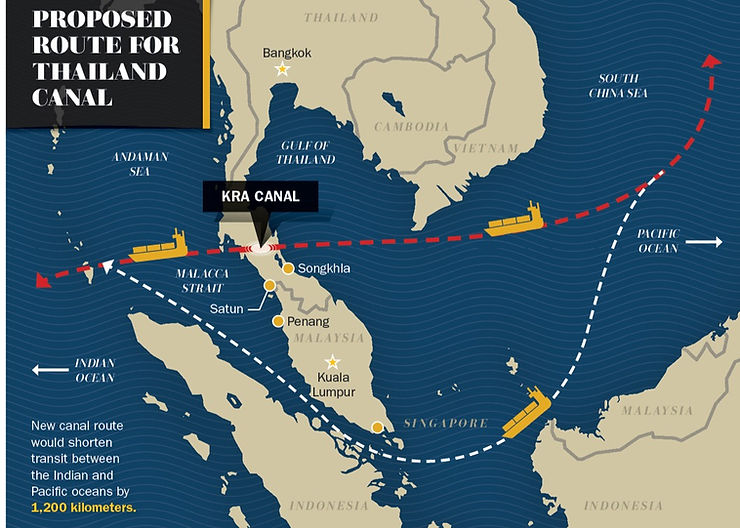
The Kra Canal’s proposed route across the Kra Isthmus — connecting the Andaman Sea to the Gulf of Thailand, bypassing the Strait of Malacca entirely. Source: straitmalacca.com
What Is the Kra Canal?
The Kra Canal — also known as the Thai Canal, the Kra Isthmus Canal, or historically the “Thai Canal” — is a proposed fully navigable waterway that would be cut through the Kra Isthmus in southern Thailand, directly connecting the Andaman Sea (Indian Ocean) with the Gulf of Thailand (Pacific side). If built, it would allow ocean-going vessels — including the world’s largest supertankers and ultra-large container ships — to sail through Thailand without stopping, bypassing the Strait of Malacca entirely.
Unlike the Thailand Land Bridge — the currently advancing overland freight corridor that requires cargo to be unloaded, trucked across the isthmus, and reloaded — the Kra Canal would function like a miniature Suez Canal or Panama Canal: ships would enter on one side, sail through the waterway, and exit on the other, with no interruption to the voyage. This is the canal’s fundamental superiority over the land bridge — and its fundamental challenge, because achieving it requires excavating one of the most technically and geopolitically complex waterways ever proposed.
At its narrowest, the Kra Isthmus is approximately 44 kilometres wide, though the most studied canal routes measure between 102 and 135 kilometres in total length, depending on the selected alignment. The proposed canal would need to be roughly 400 metres wide and 24–25 metres deep to accommodate modern Very Large Crude Carriers and post-Panamax container vessels.
The concept is not new. The Kra Canal has been discussed, studied, surveyed, and debated for more than 300 years — making it arguably the most persistently unbuilt infrastructure project in modern history. Every generation of Thai, Chinese, European, and American policymakers has returned to it. Every time, the combination of cost, politics, security, and engineering complexity has halted it. As of 2026, the Thai government has opted for the Land Bridge instead — but the canal concept refuses to die, and the Hormuz crisis has given it new strategic urgency.
The Problem the Kra Canal Was Designed to Solve
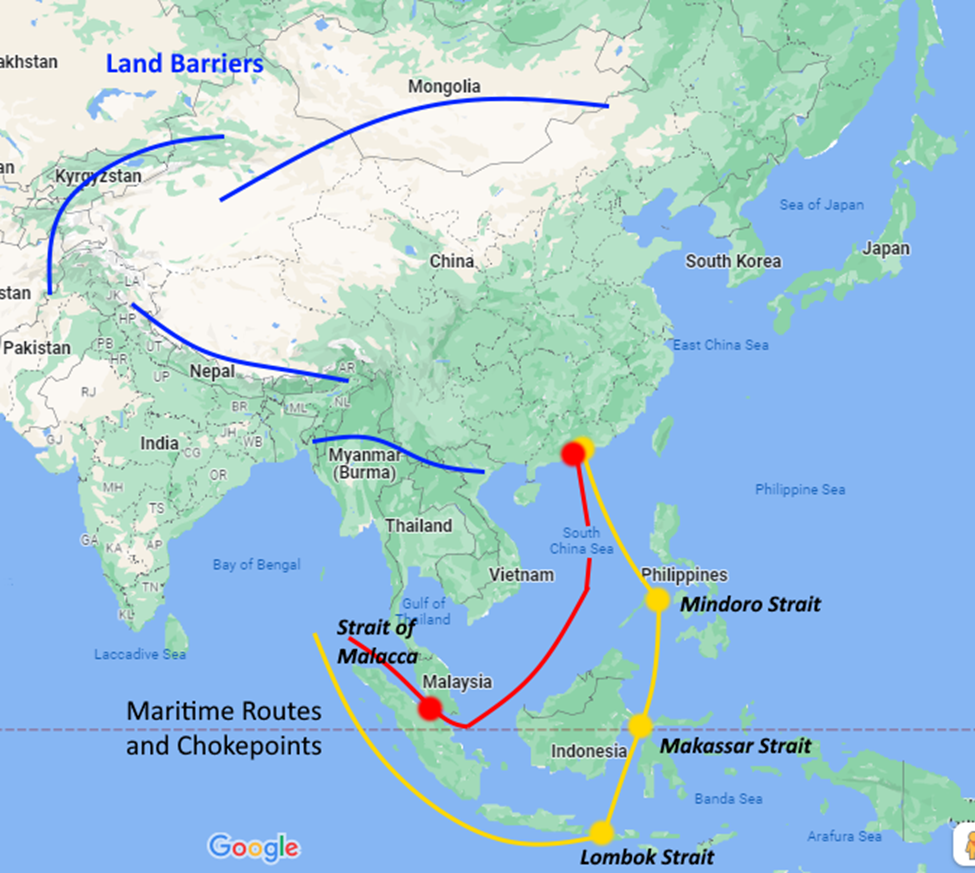
The Kra Canal has always existed as a proposed solution to a single, enduring geographic problem: the Strait of Malacca’s chokepoint monopoly over maritime trade between the Indian Ocean and the Pacific.
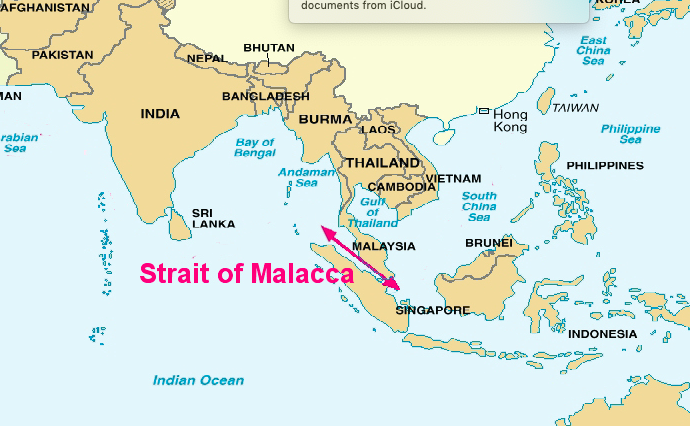
As documented in our full analysis of the Strait of Malacca Dilemma, the strait at its narrowest is just 2.8 kilometres wide, and over 100,000 vessels transit it annually carrying more than $3.5 trillion in goods. There is no efficient alternative. The Lombok and Sunda Straits add over 1,000 nautical miles and days of sailing. Routing around Australia is commercially absurd. The Strait of Malacca is a mandatory geographic funnel — and its strategic implications are enormous.
For China, the problem is existential. Approximately 80% of China’s oil imports transit Malacca. In a military conflict — over Taiwan, the South China Sea, or any other flashpoint — the United States has the naval capacity to interdict Malacca and cripple China’s energy supply without setting foot on Chinese soil. This is what President Hu Jintao called the “Malacca Dilemma” in 2003, and it has driven Chinese strategic planners toward alternatives ever since. The Kra Canal, if built with Chinese involvement, would be the most powerful solution to that dilemma yet conceived.
For commercial shipping, the problem is efficiency and cost. The detour around the Malay Peninsula adds days of sailing, fuel cost, and exposure to Malacca’s growing congestion. A Kra Canal offering 1,200 nautical miles of savings would represent genuinely meaningful reductions in global shipping costs — at the scale of tens of billions of dollars annually across the entire industry.
“The canal’s creation is, fundamentally, a challenge to the U.S. role as the dominant maritime power in the Indo-Pacific.”
— Dr. Eleanor Carter, Senior Analyst, Center for Strategic and International Studies, January 2026For Thailand, the problem being solved is economic: the country sits on the geographic solution to Asia’s greatest shipping bottleneck but has never monetised that position. A Kra Canal would generate massive, perpetual transit fee revenue — comparable to Panama’s Canal revenues — while establishing Thailand as indispensable to global maritime commerce. The problem is that every attempt to capture this value has foundered on the canal’s costs and risks.
Kra Canal vs. Thailand Land Bridge: What’s the Difference?
These two proposals are frequently conflated, but they represent fundamentally different — and in several key respects, opposing — solutions to the Malacca bypass challenge. Understanding the distinction is critical to evaluating the Kra Canal on its own terms.
| Factor | 🚢 Kra Canal (Thai Canal) | 🛤 Thailand Land Bridge |
|---|---|---|
| Core concept | Fully navigable waterway — ships sail through uninterrupted | Overland freight corridor — cargo unloaded, transported, reloaded |
| Route length | 102–135 km of excavated canal through the isthmus | ~90 km road/rail corridor connecting two ports |
| Ship transit? | Yes — ships enter one end and exit the other, non-stop | No — two separate voyages with an overland leg between them |
| Time saving | 4–6 days per voyage for many East Asia–Indian Ocean routes | Up to 4 days claimed, but partially offset by transshipment time |
| Estimated cost | $28B–$100B+ (enormous range; some engineering estimates exceed $100B) | ~$31B (997 billion baht, current Thai government figure) |
| Construction time | 10–20 years (theoretical only — never formally designed) | 7–9 years (government target; most analysts say longer) |
| Environmental impact | Catastrophic — permanently divides the Thai peninsula; marine ecosystem destruction on a massive scale | Severe — coastal ecosystems, Ramsar wetlands, UNESCO heritage areas |
| Who benefits most | China (strategic breakthrough), global shipping industry | Thailand (economic development), China (partial), Saudi Arabia |
| Singapore impact | Existential threat — Singapore’s transshipment model is bypassed entirely | Moderate threat — some traffic diversion |
| U.S. position | Strong opposition — undermines naval control of Malacca | Cautious support — acceptable alternative without sea-lane concessions |
| Security risk | Divides southern Thailand’s Muslim-majority provinces; insurgency risk | Single private operator controls entire corridor; insurgency risk lower |
| Current status (2026) | No formal government proposal; conceptual only; academically and geopolitically active | Cabinet proposal expected June–July 2026; actively advancing |
| Will it be built? | Almost certainly not in the near term; possibly never | Uncertain — feasibility contested; investors not yet committed |
The Kra Canal’s theoretical advantage is decisive: ships sail through. No cargo operations. No transshipment costs or delays. The competitive edge over Malacca is maximal. But this superiority comes at an equally decisive price — the canal requires excavating a waterway through a living landscape that would be permanently, irreversibly altered. The Land Bridge is the pragmatic compromise that Thailand has chosen; the canal remains the bolder, more consequential, more contested idea.
Three Centuries of Plans: A Full Timeline
Who Wants the Kra Canal? The Strategic Interests Behind It
The Kra Canal has never had a single, committed governmental champion. Instead, it has a constellation of interested parties — some open about their support, some operating through proxies — whose motivations are as much geopolitical as commercial.
China: The Primary Strategic Beneficiary
Beijing is the most strategically motivated external actor in the Kra Canal debate. A canal built through southern Thailand would deliver China’s most powerful solution to the Malacca Dilemma — giving Chinese supertankers and container ships a Malacca-independent route for the first time in modern history. The Kra Canal’s 21st-century revival coincides almost precisely with the launch of China’s Belt and Road Initiative and Maritime Silk Road, within which a Thai canal would be a crown jewel.
China’s interest is not limited to economics. A Kra Canal would extend PLA Navy access into the Andaman Sea, shortening Chinese naval supply lines and opening new options for dual-use port facilities in the Indian Ocean. For U.S. strategists, this is the canal’s most alarming dimension — and the primary reason Washington opposes it.
Thai Canal Advocates: The Domestic Lobby
Within Thailand, the canal has persistent champions — most prominently the Thai Canal Association for Study and Development, which periodically resurfaces with new route proposals and job creation projections (most recently claiming up to 1 million jobs). For some Thai politicians and economists, the canal represents the “charmed solution” to Thailand’s structural economic challenges — a single project that could permanently transform the country’s growth trajectory. Senior analyst Ian Storey of ISEAS has noted that the canal “resurfaces every time the Thai economy is on the skids” — a pattern visible across multiple decades.
The Commercial Shipping Industry: Interested but Cautious
Global shipping lines would benefit from a functional Kra Canal — 4–6 days of transit time saved per voyage compounds across thousands of annual sailings into enormous aggregate fuel and time savings. However, the commercial shipping industry is not advocating for the canal’s construction. It would take decades to recoup the investment, the transit fee structure is entirely unknown, and the industry is accustomed to routing around Malacca if needed via Lombok or Sunda. Commercial interest exists but is passive.
ASEAN Members: Divided and Cautious
Indonesia and Vietnam have expressed cautious interest in a canal’s potential trade benefits while remaining deeply wary of China’s expanding influence over regional infrastructure. Malaysia, which benefits from Malacca transit traffic through its ports, would face complex trade-offs. Singapore opposes any canal concept vehemently. No ASEAN consensus exists.
Why Has the Kra Canal Never Been Built? The Real Reasons
After 350 years and dozens of feasibility studies, the Kra Canal remains unbuilt. This is not an accident or an oversight — it reflects a set of deeply entrenched barriers that have consistently defeated every proposal. Understanding these barriers is essential to evaluating whether the canal will ever be built.
The Cost Problem: The Numbers Simply Don’t Add Up
The Kra Canal’s cost estimates range from $28 billion to over $100 billion, depending on the route selected, depth specifications, lock requirements, and whether full land acquisition, environmental remediation, and geopolitical risk premiums are included. At the higher end of realistic estimates, the Kra Canal would be among the largest infrastructure projects ever attempted — comparable to the Three Gorges Dam or the construction of the Channel Tunnel, but on a vastly different scale.
The Panama Canal expansion (completed 2016) cost $5.25 billion and took nearly a decade. The Suez Canal — originally built in the 1860s — required the forced labour of hundreds of thousands and cost the equivalent of tens of billions in modern terms. The Kra Canal must be built through mountainous terrain, active fault zones, and some of the most biodiverse coastal ecosystems on earth. A feasibility study commissioned under PM Prayut concluded the project was not economically feasible at the required investment level.
The Security Problem: A Canal That Divides Thailand
The Kra Isthmus’s southern section passes through Thailand’s restive, Muslim-majority southern provinces — the site of an insurgency that has killed over 7,000 people since 2004. A canal through this region would physically divide Thailand’s south from the rest of the country, creating a hard geographic barrier between the insurgent provinces and Bangkok’s security apparatus. Military analysts and successive Thai governments have identified this as an unacceptable national security risk — potentially inflaming the insurgency, complicating military logistics, and creating a permanent political wound.
A Kra Canal would create a physical waterway separating southern Thailand’s Muslim-majority Pattani, Yala, Narathiwat, and Songkhla provinces from the rest of the country. Security forces could no longer move freely between north and south by land. The insurgent provinces — which have sought varying degrees of autonomy for decades — would be geographically isolated on a peninsula between the canal and the Malaysian border. Thailand’s military and interior ministry regard this as an existential security risk that no economic benefit can offset.
The Geopolitical Problem: China or No One
The Kra Canal’s financing requires a major state or sovereign actor — private capital alone cannot absorb a $28–100 billion project with a 30+ year payback period and no established revenue track record. The only credible state actor with the appetite and capital for such a project is China. But Chinese dominance of the canal — through construction contracts, operational concessions, or debt arrangements — is precisely what the United States, India, Japan, and Singapore are determined to prevent. The geopolitical contradiction is nearly irresolvable: the canal needs Chinese money to be built, but Chinese involvement makes it unacceptable to every major democratic power in the region.
The Environmental Problem: Catastrophic and Irreversible
A 100+ kilometre canal cut through the Kra Isthmus would permanently destroy some of Southeast Asia’s most ecologically significant terrain — tropical forests, wetlands, river systems, and coastal mangroves on both the Andaman and Gulf of Thailand sides. The mixing of Andaman Sea and Gulf of Thailand marine ecosystems, which have evolved separately for millennia, would trigger unpredictable ecological cascades. Unlike the Land Bridge’s port construction (severe but localized), a canal’s environmental impact would be continental in scale and impossible to reverse.
The Logistics Problem: Do Ships Actually Benefit?
Critics point out that the Kra Canal’s time savings are unevenly distributed. For the largest supertankers already routed through Lombok or Sunda Straits (which offer greater depth than Malacca), a Kra Canal offers minimal advantage. For vessels already optimized for Malacca, the canal’s transit fees would need to be priced competitively against simply continuing on the existing route — and the Malacca route’s integrated port infrastructure (bunkering, ship repair, supply chains) at Singapore has no Kra equivalent. Some shipping analysts conclude that the real transit time saving, accounting for canal transit procedures and fees, is closer to 1 day than the 4–6 days commonly cited by proponents.
The Kra Canal is the infrastructure equivalent of a perpetually promising investment that always seems five years away from viability. The strategic logic is genuine — China needs it, shipping would benefit, Thailand sits on the geography. But every attempt to resolve the financing, security, environmental, and geopolitical barriers simultaneously has failed. The canal’s very appeal to China is precisely what makes it unacceptable to the U.S., India, and Singapore — and without resolving that contradiction, no amount of feasibility study changes the fundamental calculus.
Engineering Specifications & The True Cost of the Kra Canal
Multiple route alignments have been studied over the decades. The most recent serious proposal — designated the 9A Route — runs through Krabi, Trang, and Satun provinces and is favoured by the Thai Canal Association. Other historical proposals traverse different sections of the isthmus, with varying trade-offs between length, depth, terrain difficulty, and population displacement.
Core Engineering Specifications
Any Kra Canal capable of handling modern ocean-going vessels would require a minimum navigable width of approximately 400 metres, sufficient for two-way traffic from Very Large Crude Carriers (VLCCs). Depth must reach at least 24–25 metres to accommodate laden supertankers. The canal would need locks or a lock-free design depending on tidal differentials between the Andaman Sea and Gulf of Thailand — a significant engineering variable.
The terrain challenge is formidable. The Kra Isthmus is not flat — it includes highland terrain, river systems, and areas with significant seismic activity. Excavation volumes would be enormous. The Suez Canal required the removal of approximately 97 million cubic metres of earth; some estimates put the Kra Canal’s excavation requirement at 200–300 million cubic metres, accounting for the harder, more varied terrain.
The Cost Range Problem
Cost estimates for the Kra Canal range so wildly — from $28 billion to over $100 billion — because no authoritative engineering design has ever been completed. The lower estimates use optimistic assumptions about terrain, environmental compliance costs, and land acquisition. The higher estimates incorporate realistic contingency factors, environmental remediation, the construction of port facilities at both canal termini, access roads and infrastructure, and decades-long operational financing costs.
For reference: the Panama Canal expansion (which merely widened an existing canal) cost $5.25 billion and ran significantly over budget. The Kra Canal would need to be built from scratch through complex terrain. Most independent engineering economists place a realistic full-cost estimate north of $50 billion, with significant uncertainty at the upper end.
Panama Canal revenues in 2024 were approximately $4.9 billion on roughly 14,000 transits. A Kra Canal capturing even 20% of Malacca’s traffic (20,000 vessels per year) at competitive fees could generate $4–8 billion annually at optimistic pricing. At $50 billion construction cost, the payback period — even ignoring interest on construction debt — exceeds 8–12 years under the most favourable assumptions, and 25–50 years under realistic ones.
- Optimistic scenario: 20,000 transits/year × $250,000 avg fee = $5B/year → 10-year payback on $50B cost
- Realistic scenario: 10,000 transits/year × $150,000 avg fee = $1.5B/year → 33-year payback, excluding financing costs
- Key variable: Shipping lines will only divert to Kra if the fee + time saving is competitive against Malacca; aggressive pricing destroys the business case
- Comparable: Thailand’s Land Bridge has a government-calculated EIRR of 17.38% — the Kra Canal’s comparable figure has never been formally established
Key Players: Who Supports the Canal, Who Opposes It, and Why
Solves the Malacca Dilemma definitively. Opens PLA Navy access to the Andaman Sea. Generates construction contracts worth tens of billions for Chinese state enterprises. Extends BRI influence into the heart of Southeast Asia. China’s BRI and Maritime Silk Road frameworks are built partly around this aspiration.
The principal civil society organisation pushing for renewed feasibility studies. Claims the 9A Route could create up to 1 million jobs and generate permanent transit revenues. Lacks government backing but maintains persistent political presence in Thai discourse.
A functioning Kra Canal would directly bypass Singapore, eliminating or dramatically reducing the city-state’s role as Asia’s premier transshipment hub. Port revenues — a critical pillar of Singapore’s economy — would be severely impacted. Singapore has historically lobbied against canal proposals through diplomatic channels.
A Chinese-backed Kra Canal would fundamentally undermine U.S. naval leverage over China’s energy supply. The U.S. Navy’s ability to interdict Malacca in a conflict — its most powerful non-kinetic option against China — would be negated. Washington prefers the Thailand Land Bridge precisely because it does not create a sea-lane bypass benefiting Chinese maritime power.
India’s Andaman and Nicobar Islands provide significant maritime leverage over Malacca — leverage that would be partially negated by a Kra Canal route. A Chinese-influenced canal on India’s maritime doorstep would represent strategic encirclement. India opposes Chinese involvement in any Kra Canal project.
Successive Thai governments have declined to formally pursue the canal while never fully abandoning it. The current Anutin administration is pursuing the Land Bridge instead — but has not closed the door on the canal’s long-term future. The canal remains a “hardy perennial” of Thai political discourse.
Both nations would benefit commercially from a Kra Canal’s transit time savings — both import nearly 80% of their energy through Malacca. However, both are U.S. security partners deeply uncomfortable with Chinese strategic gains. Their interest is economically real but geopolitically constrained.
A canal through the Kra Isthmus would destroy irreplaceable tropical ecosystems, permanently alter two distinct marine environments, and displace hundreds of thousands of residents. Environmental groups regard the canal as categorically incompatible with Thailand’s biodiversity commitments and UNESCO heritage ambitions.
Global Implications: What a Built Kra Canal Would Mean for the World
The Kra Canal has never been built — but its imagined consequences have shaped geopolitical strategy across Asia for decades. If it were built, the implications would be among the most significant restructuring of maritime power in modern history.
For China’s Strategic Position: A Decisive Breakthrough
A completed Kra Canal would represent China’s most significant strategic gain since the opening of the China–Pakistan Economic Corridor. China’s Malacca Dilemma — the vulnerability that has haunted Beijing’s strategic planners since Hu Jintao named it in 2003 — would be substantially reduced. Chinese-bound supertankers and container ships would have a viable Malacca-independent route. The U.S. Navy’s ability to economically contain China through Malacca interdiction would be significantly weakened. This single shift in the balance of maritime leverage between Washington and Beijing is why the canal has never advanced: the U.S. and its allies are determined to prevent it.
For U.S. Naval Strategy: A Major Loss of Leverage
American strategic dominance in the Indo-Pacific rests partly on controlling or contesting the maritime chokepoints through which China’s energy flows. Malacca is the most important of these. A Kra Canal — particularly one with Chinese construction involvement or operational presence — would diminish this leverage, complicate the U.S. Navy’s operational planning for a Taiwan or South China Sea conflict, and extend China’s defensive perimeter deeper into the Indian Ocean. Washington’s opposition is therefore not primarily economic; it is structural and strategic.
For Singapore: An Existential Challenge
Singapore’s economic model — built around being the world’s premier transshipment hub at the southern entrance of Malacca — would face its first existential structural challenge since independence. The city-state’s Tuas Port (under construction to become the world’s largest fully automated container port) is built on the assumption of continued Malacca traffic growth. A successful Kra Canal would undermine this assumption at its foundation, diverting traffic away from Singapore’s port system.
For the Strait of Malacca: Reduced But Not Eliminated Importance
The Kra Canal would not make Malacca irrelevant. Ships trading between South Asia, East Africa, the Middle East and Southeast Asia itself would continue using Malacca. The canal’s primary benefit accrues to East Asian-bound traffic, not to intra-regional trade. Malacca would remain one of the world’s busiest waterways — but its chokepoint power, and the strategic leverage that flows from it, would be materially reduced.
For Global Energy Markets: Reduced Systemic Risk
A Kra Canal with an integrated pipeline component would allow Middle Eastern crude oil to reach East Asian refineries via a Malacca-independent route. This would reduce oil market sensitivity to a Malacca disruption scenario, potentially dampening the extreme price spikes that any Malacca crisis would otherwise produce. Given the current Hormuz crisis and its demonstration of what chokepoint closure does to global energy markets, this is a meaningful reduction in systemic risk.
For Thailand: Transformation — But at What Cost?
A Kra Canal would generate permanent transit revenues, massive construction employment, and establish Thailand as an indispensable node in global maritime trade. The canal would transform Thailand’s strategic importance in much the way Panama was transformed by its canal. But analysts at Geopolitical Monitor warn that a Chinese-financed canal could also rob Thailand of strategic autonomy — turning it into a geopolitical pawn between Beijing and Washington, with ASEAN unity potentially fracturing over the implications.
- Reduce China’s Malacca Dilemma vulnerability by 40–60%, depending on capacity achieved
- Fundamentally challenge U.S. naval leverage over Chinese energy supply lines
- Threaten Singapore’s transshipment model at its foundation
- Generate $4–8 billion annually in transit revenues for Thailand (optimistic scenario)
- Reduce global oil market sensitivity to a Malacca disruption event
- Extend PLA Navy operational options into the Andaman Sea / Indian Ocean
- Permanently destroy irreplaceable Southeast Asian ecosystems along the canal corridor
- Potentially fracture ASEAN by forcing member states to choose sides in U.S.–China competition
- Transform Thailand from a neutral “Switzerland of Southeast Asia” into a front-line geopolitical actor
External Resources & Further Reading
For readers seeking primary sources, these authoritative institutions have published the most substantive analysis of the Kra Canal: