

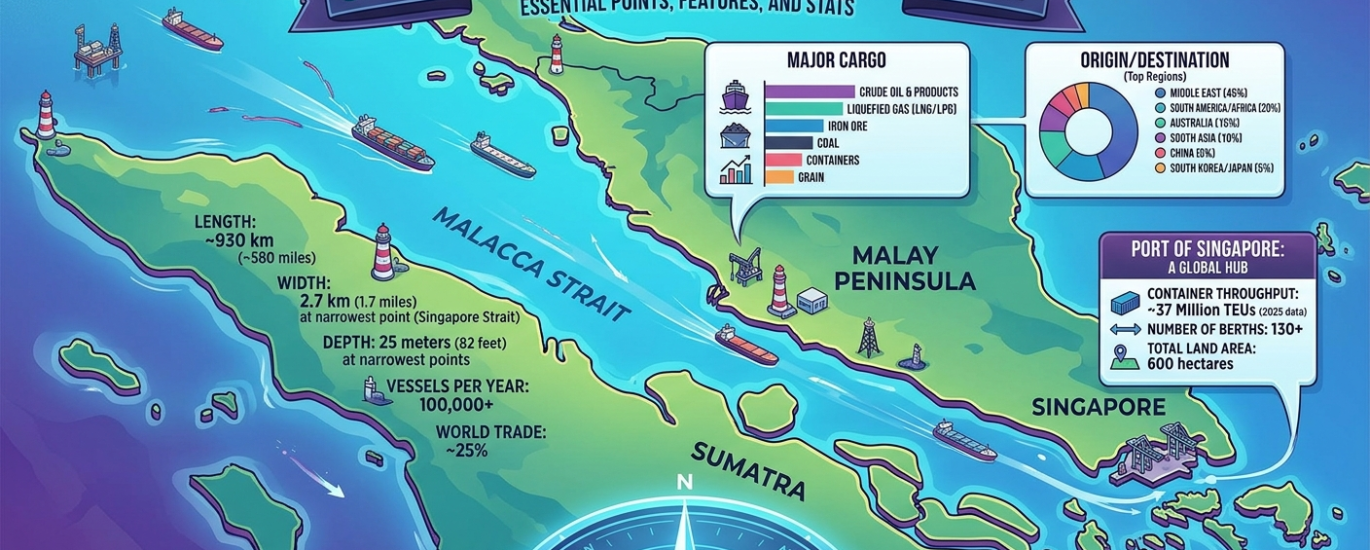
The Importance of the Strait of Malacca:
The World’s Most Critical Waterway
A narrow channel between two continents carries more than a quarter of all global trade. Here is why every nation on Earth has a stake in keeping the Strait of Malacca open — and what happens if it ever closes.
What Is the Strait of Malacca?
The Strait of Malacca is the principal maritime corridor connecting the Indian Ocean to the South China Sea and, through it, the wider Pacific Ocean. It runs between the western coast of the Malay Peninsula (Malaysia and Singapore) to the north and the Indonesian island of Sumatra to the south. At its narrowest point — the Phillips Channel near Singapore — the waterway is only about 2.8 kilometres (1.7 miles) wide, making it one of the most congested shipping passages in history.
In geopolitical terms, the Strait of Malacca is a chokepoint — a narrow stretch of water where maritime traffic must funnel through, giving it outsized strategic and economic significance. Simply put: if the strait shuts, a catastrophic portion of global trade has nowhere to go.
“The Strait of Malacca is to global trade what the jugular vein is to the human body — not the largest vessel, but the one whose obstruction is most immediately fatal.”
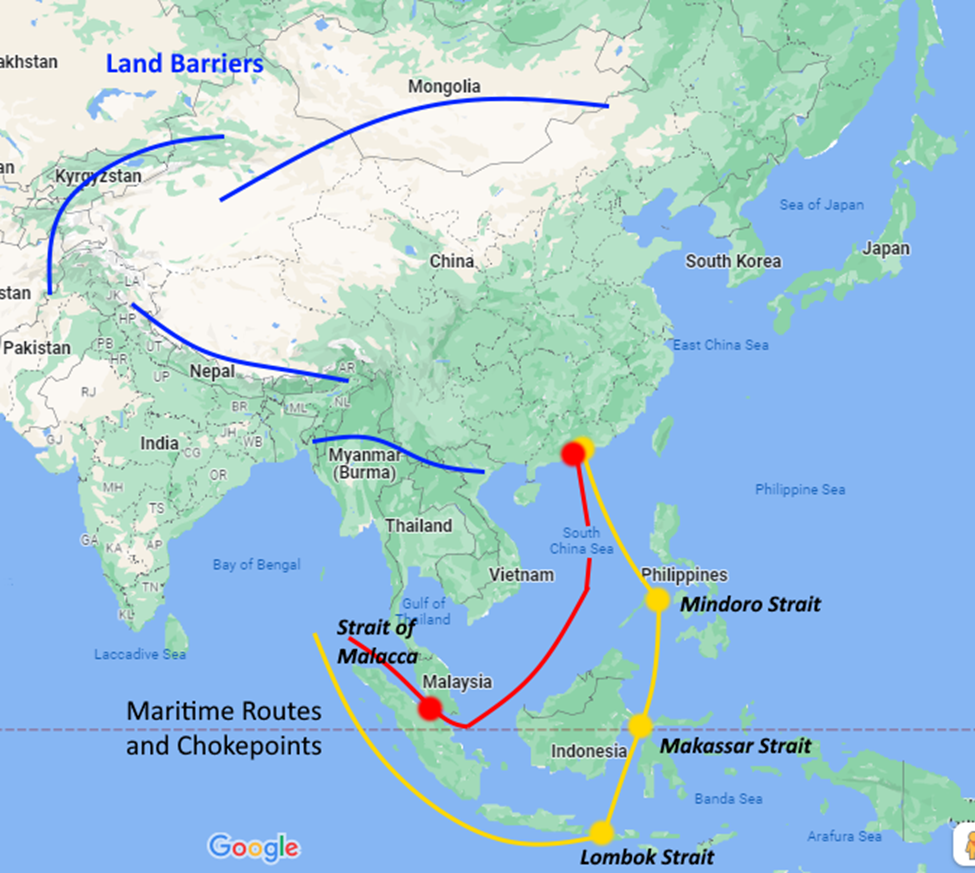
Figure 1: The Strait of Malacca — the narrow corridor connecting the Indian Ocean to the South China Sea. (Source: StraitMalacca.com)
Geography and Physical Characteristics
The strait stretches approximately 800 kilometres (500 miles) in length, running from the Andaman Sea in the northwest to the Singapore Strait in the southeast. Its width narrows progressively from around 250 km in the north to less than 3 km near Singapore.
Key Physical Facts
📐 Physical Characteristics at a Glance
- 📏Length: ~800 km (500 miles)
- ↔️Width (narrowest point): ~2.8 km — Phillips Channel, Singapore
- 📐Width (widest point): ~250 km in the northern approaches
- ⚓Minimum navigable depth: ~25 metres in the main channel — limiting very large crude carriers (VLCCs)
- 🌍Bordering countries: Malaysia, Singapore, and Indonesia
- 🌊Connected bodies: Andaman Sea (Indian Ocean) and the Singapore Strait / South China Sea
- 🚢Traffic separation scheme: Managed since 1981, co-administered by Malaysia, Singapore, and Indonesia
The shallow depth of certain sections means the very largest fully laden supertankers — specifically Ultra Large Crude Carriers (ULCCs) — cannot always transit fully loaded, adding a logistical constraint to the corridor’s physical bottleneck.
A Brief History of the Strait of Malacca
The strait has been a fulcrum of world history for over two millennia. As far back as the 1st century CE, it served as a critical node on the ancient Maritime Silk Road, linking Rome, India, and China through Arab and Indian intermediaries. The Hindu-Buddhist kingdom of Srivijaya, based in Sumatra, dominated the strait from roughly the 7th to the 13th century, extracting tolls and controlling the spice trade that enriched empires across Eurasia.
The Sultanate of Malacca (founded c. 1400 CE) emerged as the strait’s most powerful medieval gatekeeper, turning the port of Malacca into the greatest trading city in Southeast Asia. Portuguese Admiral Afonso de Albuquerque captured Malacca in 1511, recognising that control of the strait meant control of the entire Eastern spice trade. The Dutch, the British, and eventually the Americans all made the strait a cornerstone of their maritime strategy in subsequent centuries.
Today, the importance of the strait has only grown. What once carried nutmeg and pepper now carries oil, LNG, electronics, and manufactured goods — the arteries of the modern global economy.
Why the Strait of Malacca Is So Important
Understanding the importance of the Strait of Malacca requires stepping back to view global geography. The strait is the shortest sea route between the Persian Gulf and the energy-hungry nations of East Asia — China, Japan, South Korea, and Taiwan. It is also the primary connector between European and Asian markets via the Indian Ocean. No other waterway comes close to matching the volume of traffic it handles at such a narrow passage.
There are five interlocking reasons the strait’s importance is unparalleled:
1. It Is Irreplaceable for Intercontinental Shipping
The only realistic alternative routes — the Lombok Strait and Sunda Strait through Indonesia — are significantly longer, shallower, or more difficult to navigate for large vessels. A diversion via Lombok adds roughly 1,000 nautical miles to a voyage, translating to several extra days at sea, higher fuel costs, and supply chain disruptions at scale.
2. It Carries a Disproportionate Share of Global Trade
Approximately 25–30% of global trade by value passes through the strait annually, including a vast proportion of the electronics, textiles, commodities, and manufactured goods that flow between Asia, Europe, the Middle East, and Africa.
3. It Is the World’s Leading Oil Chokepoint
More crude oil passes through the Strait of Malacca than any other chokepoint in the world except the Strait of Hormuz. In recent years, daily oil flows have ranged between 15–17 million barrels per day (bpd), representing roughly 16% of global oil consumption and over a third of global LNG trade.
4. It Underpins East Asian Economic Miracles
The post-war economic transformations of Japan, South Korea, Taiwan, and — most consequentially — China, were all built on manufacturing export models that depend on secure sea lanes through the Malacca Strait. Today, China’s import-dependent energy model runs on oil shipped almost entirely through this corridor.
5. It Is a Strategic Naval Corridor
Major naval powers — the United States, India, China, and Japan — all maintain interests in ensuring (or in some scenarios, controlling) freedom of navigation through the strait. It is not merely an economic asset; it is a first-order geopolitical variable.
Figure 2: Maritime traffic density in the Strait of Malacca (2026). The concentration of vessel movement illustrates why this narrow corridor is the world’s most critical shipping lane. (Source: StraitMalacca.com)
Trade Volume and Key Statistics
Numbers tell the story more vividly than any description. The following figures represent the scale at which the strait operates, and why any disruption has immediate global consequences.
What Types of Goods Transit the Strait?
The cargo flowing through the Strait of Malacca is extraordinarily diverse, reflecting the full spectrum of the modern global economy:
🚢 Major Cargo Categories
- 🛢️Crude oil and petroleum products — primarily from the Persian Gulf to China, Japan, South Korea, and Taiwan
- 🔵Liquefied Natural Gas (LNG) — from Qatar, Australia, and the UAE to Northeast Asian buyers
- 📦Containerised manufactured goods — electronics, machinery, automotive parts, textiles, and consumer goods
- 🌾Agricultural commodities — grain, soybeans, palm oil, and rice moving across the Indo-Pacific
- ⛏️Raw materials and ores — iron ore, coal, bauxite, and copper concentrate from Australia, Africa, and South America to Asian smelters
- 💊Pharmaceuticals and chemicals — globally traded through major port hubs like Singapore and Port Klang
Who Uses the Strait of Malacca?
The strait does not serve a single nation or bloc — it is the shared infrastructure of the entire global economy. The primary users can be grouped as follows:
Energy Importers: China, Japan, South Korea, India
China is by far the largest single user, importing over 10 million barrels of oil per day, the majority of which transits the Strait of Malacca. Beijing has termed this vulnerability the “Malacca Dilemma” — the recognition that a hostile power controlling the strait could sever China’s energy lifeline almost overnight. Read more about the Malacca Dilemma here.
Japan and South Korea have virtually no domestic energy resources and import nearly all their oil and LNG through the strait. For Japan, approximately 90% of all energy imports travel this route. India relies on the strait for LNG imports and export markets, though it has greater geographic flexibility than East Asian nations.
Trade Nations: ASEAN, Europe, the Middle East
All ten ASEAN member states rely on the strait to varying degrees for both import supply chains and export markets. The European Union routes a substantial portion of its Asian trade through the strait via the Indian Ocean. Gulf states and Saudi Arabia ship the majority of their crude oil exports eastward through the strait.
The Strait’s Custodians: Malaysia, Singapore, Indonesia
The three littoral states — Malaysia, Singapore, and Indonesia — share jurisdiction over the strait under the framework of the United Nations Convention on the Law of the Sea (UNCLOS). Singapore’s entire economic model is built on its position at the southeastern entrance to the strait, making it the world’s second-busiest container port and a premier bunkering, refining, and financial hub. Malaysia hosts major ports including Port Klang and Penang, while Indonesia controls the Sumatra coastline.
Energy Security: Oil, LNG, and the Strait of Malacca
No dimension of the strait’s importance is more acute than its role in global energy security. The world’s two largest economies — the United States and China — and the world’s three largest crude importers — China, India, and Japan — all have fundamental interests in the strait’s continued accessibility.
The U.S. Energy Information Administration (EIA) has consistently ranked the Strait of Malacca among the world’s most critical energy transit chokepoints. At peak estimates, over 16 million barrels of oil per day have been recorded moving through the strait — roughly one-sixth of global daily oil consumption. Any disruption of even a week’s duration would drain strategic petroleum reserves, spike oil prices, and send shockwaves through every oil-importing economy.
LNG flows compound the risk. Australia, Qatar, and the UAE export enormous volumes of liquefied natural gas to Japan, South Korea, China, and Taiwan — all of which transit the strait. Because LNG powers electricity generation, heating, and industrial processes in these countries, a disruption has cascading effects on manufacturing output, consumer prices, and national energy security simultaneously.
What Happens If the Strait of Malacca Is Disrupted?
This is the central question that keeps defence ministers, energy ministers, and logistics executives awake at night. A closure — whether caused by conflict, terrorism, a catastrophic maritime accident, or deliberate blockade — would produce a domino sequence of economic and geopolitical shocks with no recent historical parallel.
Immediate Effects (Days 1–7)
Within hours of a confirmed closure, global oil prices would spike sharply. Historical analogies — including the Suez Canal closure of 1956 and the temporary disruptions to the Strait of Hormuz — suggest price increases of 20–40% within the first week. Freight rates for alternative routes would skyrocket. Container ship operators would scramble to reroute via the Lombok or Sunda Straits, adding days to voyage times and inflating shipping costs.
Short-Term Effects (Weeks 1–4)
Japan, South Korea, and Taiwan — all highly dependent on just-in-time energy and component delivery — would begin drawing down strategic petroleum reserves. Manufacturing would face input shortages. East Asian consumer electronics and automotive production — which collectively supplies a huge share of global consumer goods — would face component shortfalls. Grocery prices in Asian cities would begin rising.
Medium-Term Effects (1–3 Months)
A sustained closure would constitute a global economic emergency. GDP contractions would appear in energy-importing nations. Chinese industrial output — the engine of global supply chains — would face severe energy rationing. Inflation would spike in importing nations. The geopolitical pressure to reopen the strait, by force if necessary, would become overwhelming for the great powers.
“There is no modern precedent for a prolonged closure of the Strait of Malacca. The global economy has never been tested this way — and no strategic reserve system is designed to absorb it.”
Who Would Be Affected by a Strait of Malacca Closure? The Global Picture
The answer is: virtually every nation on Earth would feel the impact, albeit with very different levels of severity and through different channels. Below is a structured overview of the global impact picture.
| Country / Region | Primary Dependency | Impact Level | Key Vulnerability |
|---|---|---|---|
| China | Energy imports (~80% of oil via strait) | Critical | Industrial shutdown, energy rationing within weeks |
| Japan | ~90% of energy imports transit the strait | Critical | Near-total energy dependency; minimal alternatives |
| South Korea | Oil, LNG, and raw material imports | Critical | Semiconductor and auto manufacturing disruption |
| Taiwan | Energy imports; chip export supply chains | Critical | Semiconductor production halts affect global tech supply |
| India | LNG imports; export trade routes | High | Greater geographic alternatives than East Asia |
| Singapore | Entire economy built on strait transit | Critical | Port, refining, and financial hub operations collapse |
| Malaysia / Indonesia | Export trade and regional logistics | High | Export markets disrupted; alternative route stress |
| European Union | Asian imports and exports; consumer goods | High | Supply chain inflation; prolonged goods shortages |
| United States | Ally energy security; Asian trade partners | High | Strategic and alliance obligations; market volatility |
| Middle East / Gulf States | Asian oil export markets | High | Revenue collapse if East Asian buyers cannot receive oil |
| Sub-Saharan Africa | Commodity export routes; import supply chains | Moderate | Rising commodity prices and freight costs |
| Latin America | Commodity exports to Asia (iron ore, soy, copper) | Moderate | Demand and logistics disruption for Asian buyers |
Current Threats and Risks to the Strait of Malacca
The strait faces a constellation of risks that range from criminal to geopolitical in nature.
Piracy
The Strait of Malacca was long ranked among the world’s most dangerous piracy hotspots. Coordinated efforts by Malaysia, Singapore, Indonesia, and later India and the U.S. Navy under the Regional Cooperation Agreement on Combating Piracy (ReCAAP), launched in 2006, dramatically reduced incidents. However, low-level maritime crime persists, and the broader threat environment in surrounding waters remains active.
Geopolitical Tensions and Great-Power Competition
The deepening rivalry between the United States and China introduces the risk that the strait could become a flashpoint or a deliberate instrument of economic coercion. The U.S. Seventh Fleet maintains a commanding presence in the Indo-Pacific; China has invested heavily in naval capabilities and port infrastructure throughout the region. Any serious escalation — particularly over Taiwan — would immediately place the strait under extraordinary strategic pressure.
Environmental Hazards
The strait’s shallow waters and high vessel density create significant risk of maritime accidents, groundings, and oil spills. A major grounding event in the Phillips Channel near Singapore could temporarily close the most critical section of the passage. Climate change is also gradually altering sea levels and storm patterns in the region.
Cyber and Hybrid Threats
Modern port infrastructure — including Singapore’s world-class terminal operations — depends on digital systems vulnerable to cyber attack. A sophisticated assault on port logistics software or vessel tracking systems could create cascading delays without a single physical shot being fired.
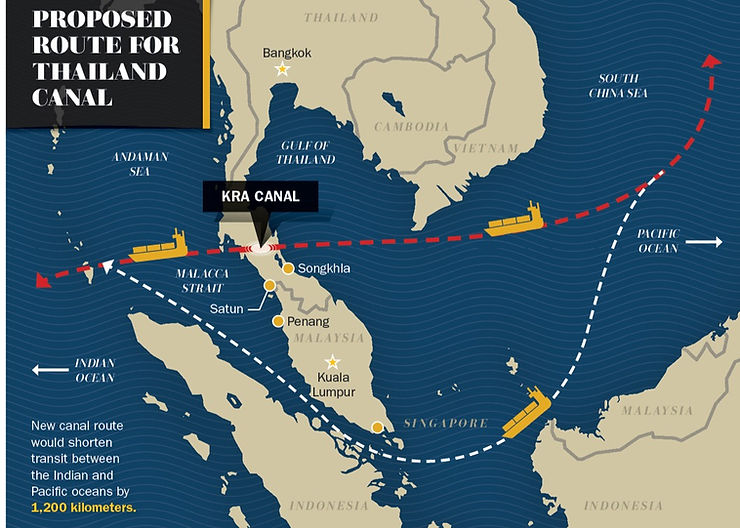
Figure 3: Proposed alternative routes and shortcuts to the Strait of Malacca, including the Kra Canal through Thailand and the Thailand Land Bridge. (Source: StraitMalacca.com)
Proposed Alternatives to the Strait of Malacca
Precisely because of the strait’s strategic importance — and the “Malacca Dilemma” it creates for China and other dependent nations — several major infrastructure projects have been proposed to reduce dependence on this single chokepoint. None has yet been built, and each faces formidable technical, financial, and political obstacles.
The Kra Canal (Thailand)
The most frequently discussed alternative is a canal cut across the Kra Isthmus in southern Thailand, which would allow vessels to bypass the entire Malay Peninsula. First proposed by the French in the 17th century and revisited repeatedly since, the Kra Canal has most recently attracted Chinese interest as part of broader Belt and Road connectivity thinking. A canal would shorten the voyage for vessels travelling between the Indian Ocean and the South China Sea by roughly 1,200 kilometres. Read the full analysis of the Kra Canal project.
The Thailand Land Bridge
A more recent proposal — and one with active Thai government interest — is the Thailand Land Bridge: a multimodal transport corridor connecting a deep-water port on Thailand’s Andaman coast to a port on its Gulf of Thailand coast, with goods transferred overland by road and rail. This approach avoids the enormous cost and complexity of canal construction while still offering an alternative routing option. Explore the Thailand Land Bridge project in depth.
Existing Alternative Sea Routes
The Lombok Strait (between the Indonesian islands of Lombok and Bali) and the Sunda Strait (between Java and Sumatra) already serve as emergency alternative routes for vessels that are too deep-drafted for the Malacca Strait or seeking to avoid congestion. However, both add significant distance and lack the infrastructure — ports, anchorages, and fuel services — that the Malacca Strait corridor provides.
The reality is stark: no current alternative fully substitutes for the Strait of Malacca. The strait’s combination of geographic position, depth, supporting port infrastructure, and logistical services means it will remain the dominant maritime corridor for the foreseeable future, whatever supplementary routes are developed.
Further Reading on StraitMalacca.com
Conclusion: The Strait of Malacca Remains Irreplaceable
The importance of the Strait of Malacca cannot be overstated. It is the single most consequential maritime corridor on Earth — a narrow ribbon of water through which passes the energy that powers Asian industrial civilisations, the goods that fill the shelves of Western consumers, and the raw materials that feed the factories of the Global South.
Its significance has compounded, not diminished, with globalisation. The deeper the world’s economic integration, the greater the damage any disruption would cause. No single alternative route, canal project, or geopolitical arrangement has yet emerged that can replicate the combination of geography, depth, infrastructure, and logistical support that the Strait of Malacca uniquely provides.
For policymakers, energy planners, supply chain professionals, and students of geopolitics alike, understanding the Strait of Malacca is not optional — it is foundational to understanding how the modern world actually works. The strait is not merely a geographical feature. It is the economic spine of the global order.