

The Strait of Malacca Dilemma: China, Global Trade & the Threat of Closure
A deep-dive into the world’s most consequential maritime chokepoint — why it keeps Beijing’s strategists awake at night, and what its closure would mean for the entire planet.
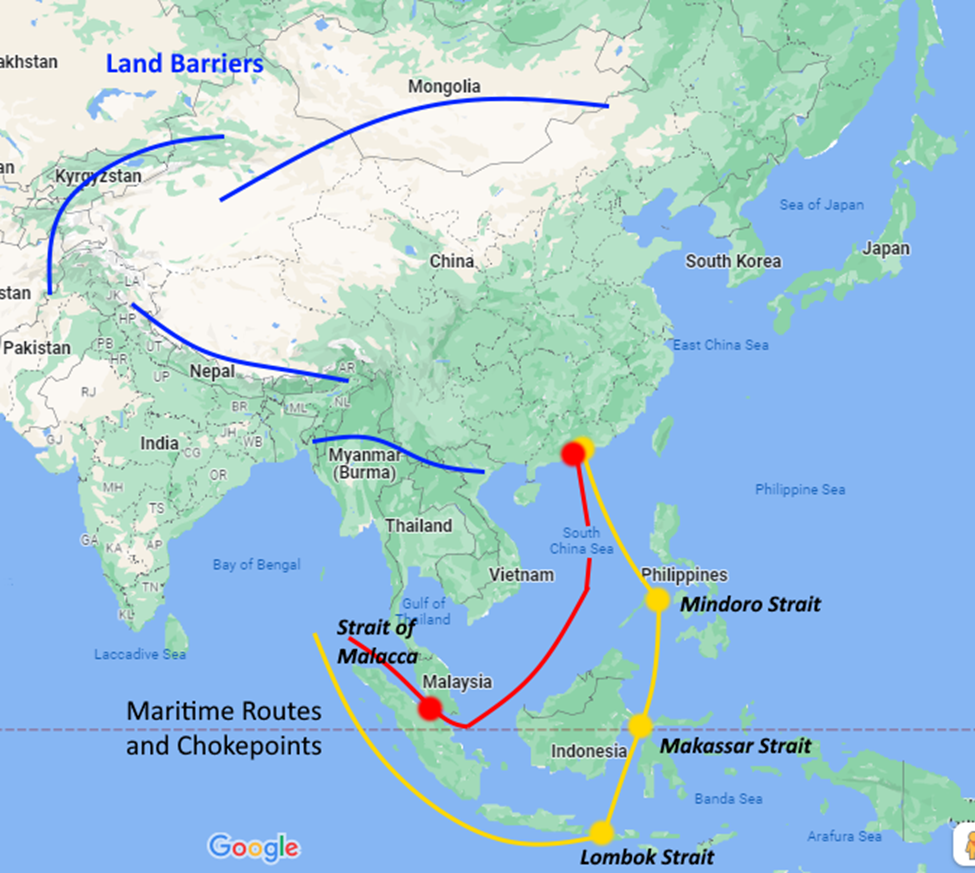
The Strait of Malacca — the 890 km waterway connecting the Indian Ocean to the South China Sea. Source: straitmalacca.com
What Is the “Strait of Malacca Dilemma”?
The Strait of Malacca Dilemma is a term that encapsulates one of the most consequential strategic vulnerabilities in 21st-century geopolitics. It describes China’s acute dependence on a single, narrow maritime passage — the Strait of Malacca — for the overwhelming majority of its energy imports and export trade, and the existential risk this dependency creates.
The phrase was first attributed to Chinese President Hu Jintao in 2003, when he acknowledged to senior Communist Party officials that China faced a “Malacca Dilemma” (马六甲困局, Mǎliùjiǎ Kùnjú). Hu’s concern was straightforward: nearly 80% of China’s oil imports at the time transited through this 2.8-kilometre-wide chokepoint. A hostile power — the United States, Japan, or India — could theoretically interdict this passage and bring China’s industrial economy to its knees without firing a single shot on Chinese soil.
To understand the full depth of the dilemma, consider that the Strait of Malacca is, mile for mile, the most economically critical body of water on Earth. More than 100,000 vessels pass through it annually, carrying roughly one-third of global trade by volume and an estimated one-quarter of all oil traded worldwide. For China alone, it is the arterial gateway through which the energy that powers its factories, cities, and military flows.
But the Malacca Dilemma does not belong to China alone. As this analysis will demonstrate, its closure — whether through conflict, piracy, environmental catastrophe, or deliberate blockade — would send shockwaves through every major economy on Earth, from Japan and South Korea to Germany and the United States.
“We are now in the grip of the Malacca Dilemma. We must find new sea lanes — or be held hostage by those who control this strait.”
The Geography That Created a Chokepoint
The Strait of Malacca stretches approximately 890 kilometres between the Malay Peninsula to the north-east and the Indonesian island of Sumatra to the south-west. At its narrowest point — the Phillips Channel near Singapore — the navigable waterway narrows to just 2.8 kilometres, making it one of the most technically challenging passages for large vessels anywhere on the planet.
The strait is flanked by three sovereign states: Malaysia and Singapore on the north-east shore, and Indonesia on the south-west. Singapore, positioned at the strait’s southern exit, has evolved into one of the world’s busiest port cities precisely because of this geography — serving as the strategic gateway between the Indian Ocean and the South China Sea.
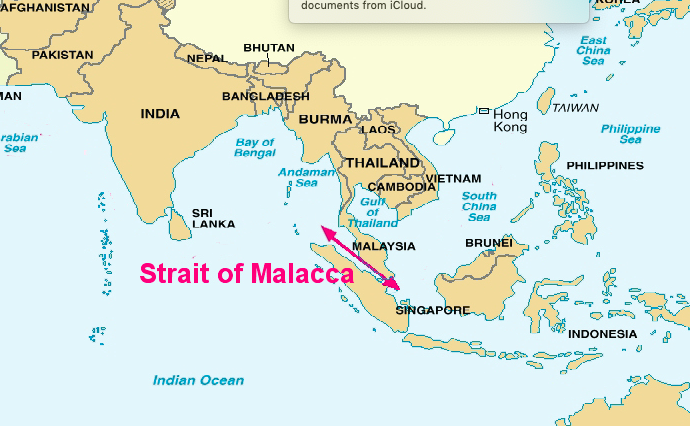
Geographically, the strait functions as the sole efficient maritime corridor connecting the Indian Ocean — and therefore the Persian Gulf, East Africa, and Europe via Suez — to the South China Sea, and onward to the Pacific economies of East Asia. Alternative routes exist — the Lombok Strait and Sunda Strait through Indonesia, or the Makassar Strait — but these add thousands of nautical miles and days of sailing time, dramatically increasing costs and fuel consumption.
The combination of its narrowness, its position at the nexus of two oceans, and the sheer density of traffic makes the Strait of Malacca uniquely susceptible to disruption. Unlike open ocean corridors, there is no practical “going around” without significant penalty.
Why It Terrifies China: A Strategic Vulnerability
China is the world’s largest importer of crude oil and one of its largest importers of liquefied natural gas (LNG). According to data from the U.S. Energy Information Administration, China imports more than 10 million barrels of oil per day. Of this, the vast majority arrives by sea — and the vast majority of that sea route passes through the Strait of Malacca.
The Structural Dependency
China’s energy geography is deeply asymmetrical. Its largest oil suppliers — Saudi Arabia, Iraq, Russia’s Pacific coast, Angola, Brazil, and the UAE — are all separated from Chinese shores by oceans and straits. The overland pipeline options (Central Asian pipelines and the Russia–China Power of Siberia pipeline) carry meaningful volumes, but nowhere near enough to compensate for a Malacca closure. China’s own domestic production covers only about 30% of its consumption needs.
This structural dependency means that any sustained interdiction of the Strait of Malacca would trigger an energy crisis within weeks, threatening industrial output, electricity generation, transportation networks, and ultimately social stability. For a government whose legitimacy rests substantially on delivering economic growth, this is an existential scenario.
The Military Calculus
From a military perspective, the strait’s closure scenario most commonly involves the United States. The U.S. Seventh Fleet, based in Yokosuka, Japan, has the capacity and historical precedent to control sea lanes across the Indo-Pacific. In the event of a military conflict over Taiwan, the Senkaku Islands, or the South China Sea, naval analysts have long argued that a U.S. naval blockade of the Strait of Malacca would be among Washington’s most powerful — and least kinetically destructive — strategic options.
China’s People’s Liberation Army Navy (PLAN), despite its remarkable modernization, remains largely focused on “near seas” operations within the first island chain. Its capacity to project force all the way to the Strait of Malacca and sustain a counter-interdiction campaign against the U.S. Navy is, at least for now, limited.
China’s Malacca Dependency at a Glance
Key strategic facts about China’s vulnerability:
- ~80% of Chinese oil imports transit through the Strait of Malacca
- China’s strategic petroleum reserve (SPR) holds roughly 90 days of consumption — barely a buffer in a prolonged blockade
- Overland pipeline alternatives (Central Asia + Russia) cover only ~15% of import needs
- Alternative sea routes (Lombok/Sunda straits) add 2–5 days of sailing and significant fuel costs
- A full closure could trigger GDP contraction of 2–4% within a single quarter, according to academic modelling
India and Japan: Secondary Leverage Points
Beyond the United States, both India and Japan maintain strategic interests at either end of the strait. India’s Andaman and Nicobar Islands sit at the northern mouth of the strait, and the Indian Navy’s growing power-projection capability has not been lost on Beijing. Japan, entirely dependent on imported energy, watches the strait with anxious vigilance — but also recognizes that its own vulnerability mirrors China’s.
How the Strait Underpins Global Trade
To frame the Malacca Dilemma solely as China’s problem is to dramatically understate its global significance. The strait is a planetary circulatory system — every major economy in the world is connected to it, directly or indirectly.
Beyond oil and LNG, the Strait of Malacca carries semiconductors from Malaysia and Singapore; electronics from China and Vietnam; automobiles from Japan and South Korea; palm oil, rubber, and agricultural commodities from Southeast Asia; and container ships loaded with consumer goods destined for markets in Europe, North America, and beyond. The UNCTAD Review of Maritime Transport consistently ranks it among the most significant maritime corridors in world commerce.
For the following economies, the Strait of Malacca is not a peripheral concern but a core national security interest:
Japan and South Korea are both almost entirely dependent on imported fossil fuels. Japan imports nearly 90% of its energy, and the vast majority arrives via the Malacca route. South Korea’s semiconductor and automotive industries are similarly exposed. A Malacca closure would hit both economies with force comparable to an oil embargo.
Taiwan — geopolitically the most sensitive economy in the Indo-Pacific — imports the bulk of its energy through this corridor. Any conflict scenario involving Taiwan would therefore be inseparable from the question of Malacca’s security.
Australia and India are major commodity exporters whose trade flows heavily through the strait. India’s imports of electronics and manufactured goods, and Australia’s exports of coal, iron ore, and LNG to East Asian buyers, all depend on Malacca’s openness.
Europe is a more indirect stakeholder, but supply chains connecting European manufacturers to Southeast Asian and East Asian suppliers run through Malacca. The disruptions experienced when the Suez Canal was briefly blocked in 2021 — by a single vessel — provided a vivid preview of how quickly maritime chokepoints translate into global supply chain crises.
If Malacca Closes: Scenarios & Consequences
What would actually happen if the Strait of Malacca were closed — whether through deliberate blockade, armed conflict, or catastrophic environmental disaster? The consequences would be stratified, but none of them would be trivial.
Scenario A: Naval Blockade in a U.S.–China Conflict
In a conflict over Taiwan or the South China Sea, a U.S.-led coalition blockade of the Strait of Malacca would be a high-value, relatively low-risk strategic option for Washington. It would not require kinetic strikes on Chinese territory, yet it could rapidly degrade China’s economic capacity to sustain military operations. China’s strategic petroleum reserve, estimated at roughly 90 days of consumption, would begin to shrink immediately. Within two to three months, rationing would begin; within six, industrial production would be severely constrained.
Strategic Alert: Blockade Timeline
Academic simulations by the RAND Corporation and others suggest that a sustained Malacca blockade lasting 90+ days would produce GDP contraction, energy rationing, and severe industrial disruption in China — but would simultaneously trigger global commodity price shocks affecting every importing nation on Earth.
Scenario B: Piracy Escalation or Non-State Actor Disruption
The strait has historically been a hotspot for maritime piracy. While coordinated efforts by Malaysia, Indonesia, Singapore, and international naval forces dramatically reduced piracy in the 2000s, the threat has never been fully extinguished. A well-organized non-state actor campaign targeting Very Large Crude Carriers (VLCCs) or LNG tankers in the Phillips Channel could force temporary route diversions, spike insurance premiums, and create significant disruption without a single state actor pulling the trigger.
Scenario C: Environmental Catastrophe
A major oil spill from a VLCC grounding in the strait’s narrowest section could render the channel temporarily impassable and cause ecological devastation affecting the fishing industries and water supplies of Malaysia, Indonesia, and Singapore. Given the sheer density of traffic, such an event is not implausible — it is, arguably, statistically overdue.
Immediate Global Economic Effects of Closure
Regardless of the cause, a Malacca closure would produce predictable effects: an immediate spike in crude oil and LNG prices globally; a surge in container shipping rates as vessels rerouted to Lombok, Sunda, or around Australia; supply chain disruptions cascading through automotive, electronics, and consumer goods sectors worldwide; and a sharp economic contraction in Japan, South Korea, and Taiwan — economies with little buffer capacity.
Malacca vs. Hormuz: A Comparative Analysis
Any expert analysis of the Strait of Malacca Dilemma is incomplete without a direct comparison to the Strait of Hormuz — the other great maritime chokepoint of the modern world. Together, these two straits function as the twin jugular veins of the global energy economy.
| Factor | Strait of Malacca | Strait of Hormuz |
|---|---|---|
| Location | Between Malay Peninsula & Sumatra, SE Asia | Between Iran & Oman/UAE, Persian Gulf exit |
| Narrowest width | ~2.8 km (Phillips Channel) | ~55 km navigable shipping lane |
| Annual vessel transits | ~100,000 vessels/year | ~21,000 tankers/year |
| Oil flow | ~16–18 million barrels/day (all petroleum products) | ~21 million barrels/day (crude + products) |
| Primary commodity | All trade goods + energy (mixed cargo) | Predominantly crude oil and LNG |
| Alternative routes | Lombok, Sunda, Makassar (costly but viable) | No viable alternative; requires Saudi East–West pipeline for partial bypass |
| Bordering states | Malaysia, Singapore, Indonesia (all stable democracies) | Iran, Oman, UAE (Iran is hostile actor) |
| Primary threat actor | U.S. naval power; piracy; conflict escalation | Iran’s Islamic Revolutionary Guard Corps (IRGC); mines; anti-ship missiles |
| Most exposed economies | China, Japan, South Korea, Taiwan, EU (indirectly) | EU, Japan, South Korea, India, U.S. (historically) |
| Geopolitical stability | High (regional cooperation strong) | Low (Iran-West tensions structurally persistent) |
| Probability of closure | Low in peacetime; elevated in Sino-U.S. conflict | Moderate; IRGC has harassed tankers repeatedly since 2019 |
| Global GDP impact of closure | Estimated –2% to –4% global GDP (sustained) | Estimated –3% to –5% global GDP (sustained) |
Key Differences in Character
The Hormuz Strait carries a higher proportion of pure crude oil — it is the exit valve for Saudi Arabia, Iraq, Kuwait, UAE, and Iran’s oil exports, making it the world’s single most oil-critical chokepoint. A sustained Hormuz closure would hit global oil supply harder and faster than Malacca, triggering near-immediate $150–$200/barrel oil price scenarios according to several financial institutions’ stress-test models.
However, the Strait of Malacca’s significance is more diversified and arguably deeper in its supply chain implications. It carries not just energy but the full spectrum of manufactured goods, semiconductor components, agricultural commodities, and consumer products. Its closure would therefore disrupt not just energy markets but virtually every global supply chain simultaneously — a more complex and harder-to-manage shock.
Hormuz also faces a more proximate and persistent threat actor: Iran. Tehran has demonstrated both the will and capability to harass, seize, and threaten tankers in the Persian Gulf, as evidenced by multiple IRGC naval incidents between 2019 and 2024. The Malacca strait’s riparian states, by contrast, are relatively stable democracies with strong institutional interest in keeping it open.
If Hormuz is the world’s oil tap, Malacca is its entire plumbing system. Closing one is an energy crisis. Closing the other is civilizational disruption.
The Dual Closure Nightmare
Geopolitical analysts at institutions including the International Institute for Strategic Studies (IISS) have modelled a “dual closure” scenario — simultaneous disruption of both Hormuz and Malacca, which could occur in a broader Middle East–Indo-Pacific conflict. The combined effect would be catastrophic: oil prices beyond historical precedent, global industrial production collapse within months, and food security crises as fuel-dependent agricultural systems failed. This remains a low-probability scenario, but its consequences are sufficiently severe to justify serious contingency planning.
Global Implications Beyond China
The world beyond China faces a distinct but equally serious set of vulnerabilities if the Strait of Malacca were closed. While Beijing’s predicament gets most of the analytical attention, the rest of the world is arguably equally exposed — and in some cases, more so.
Japan and South Korea: Total Exposure
Japan and South Korea would face near-total energy disruption within weeks of a Malacca closure. Japan imports approximately 90% of its energy, the majority of which transits the strait. Its liquefied natural gas imports — which fuel its post-Fukushima power sector — would be among the first casualties. South Korea, whose economy depends on energy-intensive semiconductor fabrication and heavy industry, faces a structurally similar vulnerability. Both countries maintain strategic reserves, but these would be exhausted within months of a sustained closure.
Southeast Asian Economies: Direct Economic Shock
Malaysia, Singapore, Indonesia, Thailand, and Vietnam would face both direct disruption and severe economic fallout. Singapore’s entire economic model — built around its status as the world’s second-busiest port and a regional hub for refining, financial services, and transshipment — would be undermined by any closure of the strait on which it sits. Malaysia’s oil export revenues would be compromised. Indonesia’s ability to service its debt and import essential goods would diminish rapidly.
Europe: Indirect but Significant
European economies are more insulated from a Malacca closure than Asian ones, but not immune. The EU relies on East Asian supply chains for electronics, machinery, and consumer goods — all of which would face severe disruption. European automakers dependent on Taiwanese semiconductors and South Korean battery components would be forced into production stoppages within weeks. The World Bank estimates that a significant disruption in East Asian trade flows would reduce EU GDP growth by 0.5–1.5% in the first year.
Global Food Security
An often-overlooked dimension of the Malacca Dilemma is food security. Southeast Asia is the world’s largest producer and exporter of palm oil, a commodity embedded in an astonishing range of processed foods globally. A Malacca closure would disrupt palm oil exports from Indonesia and Malaysia, affecting global food supply chains from biscuits to biodiesel. Combined with fuel price shocks reducing agricultural output worldwide, a prolonged closure could contribute to food inflation and supply deficits, particularly in lower-income importing nations.
Financial Markets: Immediate Contagion
Financial markets would react to a confirmed Malacca closure with extreme speed. Crude oil futures, LNG spot prices, shipping freight rates, and the equity prices of energy-intensive industries would move violently within hours. Historically, even relatively minor geopolitical events in chokepoint regions — such as Houthi attacks on Red Sea shipping in 2023–2024 — produced measurable global supply chain disruptions. A full Malacca closure would be of an entirely different magnitude.
China’s Counter-Strategies: How Beijing Is Trying to Escape the Dilemma
Recognizing the existential nature of the Malacca Dilemma since at least the early 2000s, China has pursued a multi-layered strategy to reduce — though not eliminate — its dependency on the strait.
The Belt and Road Initiative (BRI) and Overland Pipelines
The most ambitious element of China’s counter-strategy is the China–Myanmar Oil and Gas Pipeline, which runs from the Bay of Bengal port of Kyaukphyu directly to Yunnan Province. This pipeline bypasses the Strait of Malacca entirely, allowing Chinese imports from the Middle East and Africa to be offloaded in Myanmar and piped directly into China. Its capacity, however, is limited — roughly 440,000 barrels per day for oil — a fraction of China’s needs.
The broader Belt and Road Initiative includes numerous infrastructure projects designed to build alternative energy corridors: the China–Pakistan Economic Corridor (CPEC) with its Gwadar port, Central Asian pipelines, and rail connections across Eurasia. These projects collectively aim to give China at least partial energy import redundancy, but they remain far from providing a full alternative to the Malacca sea route.
Strategic Petroleum Reserve Expansion
China has invested heavily in expanding its Strategic Petroleum Reserve capacity. While exact figures are not publicly disclosed, estimates place its current capacity at 90+ days of consumption — a meaningful buffer, but insufficient for a prolonged conflict scenario.
Naval Power Projection
China’s PLAN modernization, including its growing carrier fleet, submarine force, and the construction of naval facilities from Djibouti to Gwadar, reflects a long-term ambition to project naval power far enough to complicate any attempted Malacca interdiction. However, even optimistic assessments of PLAN capability suggest this ambition will not be fully realized until the 2030s at the earliest.
The Kra Canal: The Great Bypass That Never Was
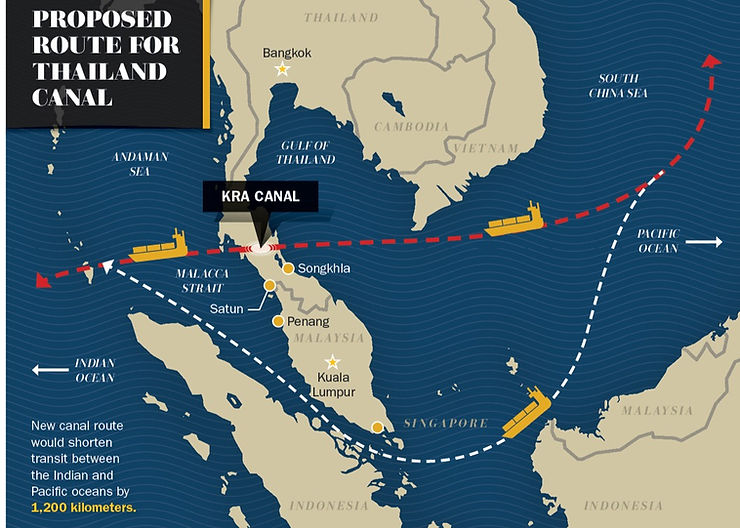
For decades, China and Thailand have periodically discussed the construction of a canal across the Kra Isthmus in southern Thailand — a project that would create a direct sea lane from the Andaman Sea to the Gulf of Thailand, bypassing the Strait of Malacca entirely. Proponents argue it would shorten shipping routes by roughly 1,200 kilometres and eliminate the chokepoint vulnerability. Critics point to its estimated cost of $25–$30 billion, environmental concerns, geopolitical complications, and Singapore’s fierce opposition to the project, which would devastate its transshipment-based economy. As of 2026, the Kra Canal remains a recurrent geopolitical discussion item rather than an imminent reality.
External Resources & Further Reading
For readers seeking to deepen their understanding of the Strait of Malacca Dilemma and global maritime security, the following authoritative sources are recommended:
FAQs: The Strait of Malacca Dilemma
The Strait of Malacca Dilemma refers to China’s strategic vulnerability arising from its overwhelming dependence on the Strait of Malacca for energy imports. Coined by Chinese President Hu Jintao in 2003, the term captures the risk that a hostile power could blockade this narrow waterway — cutting off the bulk of China’s oil supplies — without direct military engagement on Chinese soil. More broadly, it also describes the global risk that any disruption of this vital chokepoint poses to world trade and energy markets.
Approximately 80% of China’s crude oil imports transit the Strait of Malacca. Given that China imports over 10 million barrels of oil per day, this translates to roughly 8 million barrels daily flowing through this single chokepoint. The remaining imports arrive via overland pipelines from Central Asia and Russia, or are offloaded at Myanmar’s Kyaukphyu port and piped overland — but these alternatives cover only a fraction of China’s total import requirement.
In peacetime, a closure is extremely unlikely. The strait’s riparian states — Malaysia, Singapore, and Indonesia — have strong institutional and economic interests in keeping it open, and all three cooperate actively with international naval forces on anti-piracy and maritime security. However, in the context of a major Sino-U.S. military conflict, a U.S.-led naval blockade of the strait is a credible strategic option that military planners on both sides have gamed out extensively. A partial disruption through piracy escalation, a major vessel grounding, or environmental catastrophe is a lower-threshold but still consequential risk.
Both are catastrophic, but in different ways. The Strait of Hormuz carries a higher volume of crude oil — approximately 21 million barrels per day versus Malacca’s 16–18 million — and has no viable alternative route, making a closure more immediately severe for global oil prices. The Strait of Malacca, however, carries a far broader range of goods beyond oil, including semiconductors, electronics, consumer products, and agricultural commodities. Its closure would therefore cause a more complex, multi-sector supply chain shock. Hormuz is more of a pure energy crisis; Malacca is an everything crisis.
Financial analysts and energy economists estimate that a confirmed, sustained closure of the Strait of Malacca would push Brent crude oil prices to $120–$180 per barrel within days, depending on the perceived duration and severity of the disruption. LNG prices would spike even more sharply, given tighter alternative supply. Beyond energy, global container shipping freight rates would surge as vessels rerouted to alternative, longer passages — reminiscent of, but far larger than, the disruption caused by Houthi attacks on Red Sea shipping in 2023–2024.
The Kra Canal is a long-proposed infrastructure project that would cut a shipping canal across the Kra Isthmus in southern Thailand, creating a direct maritime route from the Andaman Sea (Indian Ocean) to the Gulf of Thailand (Pacific side), completely bypassing the Strait of Malacca. For China, it would partially resolve the dilemma by eliminating the chokepoint entirely for that route. However, the project faces enormous obstacles: an estimated cost of $25–$30 billion, significant environmental concerns, Thailand’s domestic political divisions over the project, and fierce opposition from Singapore, whose port economy depends on Malacca transit traffic. As of 2026, it remains a theoretical solution rather than an actionable project.
U.S. strategic planners have long recognized that China’s Malacca dependency gives Washington significant leverage in any potential conflict scenario. The ability to interdict China’s energy supply lines without deploying forces to Chinese territory is a powerful asymmetric option. This awareness shapes U.S. posture toward maintaining naval dominance in the Indian Ocean and Indo-Pacific, sustaining alliances with Singapore, Malaysia, and India, and keeping naval assets within range of the strait. For China, this knowledge is precisely why it has invested so heavily in naval modernization, alternative pipeline routes, and strategic reserves — to reduce the credibility and effectiveness of this leverage.
Japan and South Korea face near-total energy disruption in a closure scenario, as both are almost entirely dependent on imported fossil fuels transiting the strait. Taiwan’s economy — and therefore its resilience in any conflict scenario — would be severely compromised. Singapore, whose entire economic model is built around strait transit, would face existential economic disruption. Indonesia and Malaysia would suffer direct trade and energy revenue losses. More broadly, the European Union and global supply chains dependent on East Asian manufacturing would face significant secondary shock through supply chain disruptions even if they are not directly energy-dependent on the strait.