

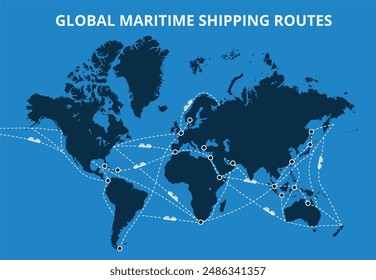
The global economy does not move on highways or through the cloud; it moves on water. Over 80% of all international trade is transported by sea, navigating a complex network of deep-water hubs, transshipment terminals, and strategic chokepoints.
Understanding the flow of this cargo requires looking at the critical nodes—the busiest international seaports—that connect the East to the West. From the manufacturing powerhouses of the Pacific to the energy corridors of the Middle East, these maritime hubs dictate the speed, cost, and security of global supply chains.
For a deeper dive into the specific geographic bottlenecks that dictate these shipping routes, read our comprehensive guide on the importance of the Strait of Malacca.
Here is a breakdown of the most critical seaports controlling international and regional trade across the globe.
1. East & Southeast Asia: The Pacific & Malacca Corridors
| Country | Primary Busiest Ports | Strategic Trade Role |
| China | Shanghai, Ningbo-Zhoushan, Shenzhen, Guangzhou, Qingdao, Tianjin | The world’s largest export hubs; Shanghai is the busiest container port globally. |
| Japan | Tokyo, Yokohama, Nagoya, Kobe, Osaka | High-value electronics, automotive exports, and raw material imports. |
| Vietnam | Ho Chi Minh City (Cat Lai), Hai Phong, Cai Mep | Rapidly growing manufacturing and alternative supply chain hubs. |
| Philippines | Manila, Cebu | Domestic transshipment and regional container trade. |
| Thailand | Laem Chabang, Bangkok | Automotive and agricultural exports; gateway to the Gulf of Thailand. |
| Malaysia | Port Klang, Tanjung Pelepas | Major transshipment hubs directly competing with Singapore along the Malacca Strait. |
| Indonesia | Tanjung Priok (Jakarta), Surabaya, Belawan | Largest economy in Southeast Asia; critical for regional raw materials and domestic trade. |
| Singapore | Port of Singapore | The world’s premier transshipment hub and busiest refueling (bunkering) port. |
| Myanmar | Yangon, Thilawa | Primary gateway for Burmese imports and agricultural exports. |
This region boasts the highest concentration of mega-ports in the world, driven by China’s manufacturing output and the vital transshipment routes of Southeast Asia.
- China: China dominates global shipping volume. The Port of Shanghai is the busiest container port in the world, serving as the primary gateway for Chinese exports. Other critical hubs include Ningbo-Zhoushan (the largest by total cargo tonnage), Shenzhen, Guangzhou, and Qingdao.
- Singapore: The Maritime and Port Authority of Singapore oversees the world’s premier transshipment hub. It is the busiest refueling (bunkering) port globally, acting as the primary sorting center for cargo entering or exiting the Malacca Strait.
- Malaysia: Directly competing for Malacca Strait traffic, Port Klang and the Port of Tanjung Pelepas offer massive transshipment capacity and lower handling fees.
- Japan & South Korea: The Port of Tokyo and Yokohama handle high-value tech and automotive exports. In South Korea, Busan stands as a massive Pacific transshipment center.
- Emerging Hubs: Vietnam’s Ho Chi Minh City (Cat Lai) and Thailand’s Port of Laem Chabang are rapidly growing as manufacturing supply chains diversify across Southeast Asia.
2. South Asia: The Indian Ocean Network
| Country | Primary Busiest Ports | Strategic Trade Role |
| Bangladesh | Chittagong (Chattogram), Mongla | Handles over 90% of Bangladesh’s massive textile export trade. |
| India | Nhava Sheva (Jawaharlal Nehru Port – Mumbai), Mundra, Chennai, Kolkata | Gateways to the subcontinent; Mundra is a major commercial logistics hub. |
| Sri Lanka | Colombo, Hambantota | Critical deep-water transshipment point for cargo moving between Asia and Europe. |
As vessels cross the Indian Ocean, South Asian ports serve as vital gateways to massive domestic markets and stepping stones toward Europe.
- India: Jawaharlal Nehru Port (Nhava Sheva) in Mumbai is the premier container handler for the subcontinent. On the west coast, the privately run Mundra Port has become a massive logistics and commercial hub.
- Sri Lanka: The Port of Colombo is a critical deep-water transshipment point. Because India lacks sufficient deep-draft ports for mega-ships, Colombo handles much of the cargo being fed into the Indian market from the main East-West sea lanes.
- Bangladesh: The Chittagong Port Authority manages over 90% of Bangladesh’s massive textile and garment export trade.
3. The Middle East: Energy and Transshipment
| Country | Primary Busiest Ports | Strategic Trade Role |
| United Arab Emirates | Jebel Ali (Dubai), Fujairah, Khalifa Port (Abu Dhabi) | Jebel Ali is the Middle East’s busiest commercial hub; Fujairah is a massive oil bunkering port just outside Hormuz. |
| Iran | Bandar Abbas, Chabahar | Bandar Abbas dominates the northern shore of the Strait of Hormuz for container and bulk trade. |
| Oman | Salalah, Sohar, Duqm | Positioned outside the Strait of Hormuz, providing vital alternative deep-water transshipment routes. |
Ports in this region are defined by their proximity to the world’s most sensitive energy transit routes and their massive investments in automated logistics.
- United Arab Emirates: Jebel Ali Port (DP World) in Dubai is the undisputed commercial hub of the Middle East, offering unmatched free-trade zone integration. Nearby, the Port of Fujairah sits just outside the Strait of Hormuz, operating as one of the world’s top three oil bunkering hubs.
- Oman: The Port of Salalah and the Port of Duqm are strategically positioned on the Arabian Sea, offering container ships a way to bypass the Persian Gulf entirely.
4. The African Coastline: Gateways to Growth
| Region / Country | Primary Busiest Ports | Strategic Trade Role |
| North Africa | Tanger Med (Morocco), Port Said (Egypt), Alexandria (Egypt) | Tanger Med and Port Said control the entrances to the Mediterranean and the Suez Canal. |
| East Africa | Mombasa (Kenya), Dar es Salaam (Tanzania), Djibouti | Djibouti controls access to the Red Sea; Mombasa and Dar es Salaam are gateways to landlocked Central Africa. |
| South Africa | Durban, Cape Town, Port Elizabeth (Ngqura) | Durban is Sub-Saharan Africa’s busiest general cargo port and vital for the Cape of Good Hope route. |
| West Africa | Lagos (Apapa/Tin Can – Nigeria), Tema (Ghana), Abidjan (Ivory Coast), Dakar (Senegal) | Critical hubs for oil, agriculture, and importing manufactured goods to massive populations. |
Africa’s seaports are undergoing massive modernizations to handle the continent’s booming population and rich raw material exports.
- North Africa: Morocco’s Tanger Med has rapidly become the largest port in Africa, strategically commanding the entrance to the Strait of Gibraltar. Egypt’s Port Said controls the vital northern access to the Suez Canal.
- East Africa: The Kenya Ports Authority manages Mombasa, the primary gateway to landlocked Central Africa, while Tanzania’s Dar es Salaam handles heavily competing regional trade.
- South Africa: Transnet National Ports Authority operates the Port of Durban, Sub-Saharan Africa’s busiest general cargo port, and Cape Town, a vital stopover for the Cape of Good Hope route.
- West Africa: Nigeria’s Lagos Port Complex (Apapa/Tin Can) and Ghana’s Tema Port are the dominant entry points for manufactured goods flowing into the region’s massive consumer markets.
5. Europe: The Northern Range and the Mediterranean
| Region | Primary Busiest Ports | Strategic Trade Role |
| Northern Europe | Rotterdam (Netherlands), Antwerp (Belgium), Hamburg (Germany), Felixstowe (UK) | The “Northern Range” handles the vast majority of goods entering the European consumer market. |
| Southern Europe | Valencia (Spain), Algeciras (Spain), Piraeus (Greece), Gioia Tauro (Italy) | Piraeus serves as a massive entry point for Asian goods; Algeciras controls the Strait of Gibraltar. |
European trade is highly consolidated, entering through massive, highly automated hubs before being distributed via rail and river barges.
- Northern Europe: The Port of Rotterdam in the Netherlands is Europe’s undisputed heavyweight, controlling the “Northern Range” alongside Antwerp (Belgium) and Hamburg (Germany).
- Southern Europe: Spain’s Port of Algeciras handles immense volume moving through Gibraltar. Further east, the Port of Piraeus (Greece) serves as the primary Mediterranean entry point for Asian goods arriving via the Suez Canal.
6. The Americas: Trans-Pacific and Trans-Atlantic Hubs
| Region | Primary Busiest Ports | Strategic Trade Role |
| Northern Europe | Rotterdam (Netherlands), Antwerp (Belgium), Hamburg (Germany), Felixstowe (UK) | The “Northern Range” handles the vast majority of goods entering the European consumer market. |
| Southern Europe | Valencia (Spain), Algeciras (Spain), Piraeus (Greece), Gioia Tauro (Italy) | Piraeus serves as a massive entry point for Asian goods; Algeciras controls the Strait of Gibraltar. |
| Country / Region | Primary Busiest Ports | Strategic Trade Role |
| Brazil | Santos, Rio de Janeiro, Paranaguá | Santos is the busiest port in Latin America, dominating agricultural (soy/coffee) and container trade. |
| Colombia | Cartagena (Caribbean coast), Buenaventura (Pacific coast) | The only South American nation with major ports on two oceans. |
| Venezuela | Puerto Cabello, La Guaira | Historically significant hubs for the northern coast, largely focused on oil and regional imports. |
| Caribbean | Kingston (Jamaica), Caucedo (Dominican Republic), Freeport (Bahamas), San Juan (Puerto Rico) | The primary transshipment “crossroads” where cargo is sorted for the Americas following Panama Canal transit. |
The Western Hemisphere relies on massive coastal gateways to process both Asian imports and agricultural/energy exports.
- United States (West Coast): The Port of Los Angeles and the adjoining Port of Long Beach form the largest seaport complex in the Western Hemisphere, acting as the primary terminus for Trans-Pacific trade.
- United States (East & Gulf Coasts): The Port of New York/New Jersey dominates the Atlantic trade, while the Port of Houston is the unmatched center for petrochemical and oil exports.
- Brazil: The Port of Santos is the busiest port in Latin America. It dictates the global flow of agricultural commodities, particularly coffee, soy, and sugar.
- The Caribbean: Ports like Kingston (Jamaica) and Caucedo (Dominican Republic) operate as vital “crossroads” hubs, sorting cargo from mega-ships passing through the Panama Canal before distributing it to smaller regional ports.